Choosing the Best Programmable Thermostat usually comes down to three practical questions: how much control you want, how easy the installation should be, and whether your system needs a C-wire. Some households only need a straightforward schedule that keeps temperatures steady. Others want app control, usage reports, or compatibility with smart home platforms. The right model depends on how you actually use your heating and cooling system, not on how many features the box lists.
Quick Answer
If you want a simple, reliable programmable thermostat, a basic model like the Honeywell Home RTH20B is often enough for single-stage systems. If you want app control and energy tracking, the Sensi Smart Thermostat and Sensi Lite Smart Thermostat are strong value choices. For more advanced scheduling and broader compatibility, the Honeywell Home RTH7600D, Google Nest Thermostat, and ecobee Smart Thermostat Essential cover a wider range of needs. If you already rely on Alexa, the Amazon Smart Thermostat is worth a close look.
Comparison Table
| Product | Best For | Key Strength | Notable Trade-Off |
|---|---|---|---|
| Honeywell Home RTH20B | Basic scheduling | Simple 5-2 programming and easy everyday use | Limited to single-stage systems |
| Sensi Smart Thermostat | Privacy-conscious smart control | Wi-Fi features with a traditional thermostat layout | Less feature-rich than higher-end smart models |
| Honeywell Home RTH7600D | Flexible home schedules | 7-day programming with touchscreen control | Requires a bit more setup than basic thermostats |
| Google Nest Thermostat | Smart automation | App-based control and occupancy-based adjustments | Best fit for users already comfortable with Google Home |
| Google Nest Thermostat Snow | Premium Nest finish | Same smart features in a different colorway | Costs more than the charcoal model |
| ecobee Smart Thermostat Essential | Smart home flexibility | Broad platform support and optional sensor expansion | Higher initial cost |
| Honeywell Home RTH9600WF | Feature-rich smart thermostat | Color display and detailed comfort information | C-wire required |
| Amazon Smart Thermostat | Alexa households | Easy integration with Alexa and Ring | C-wire required |
| Sensi Lite Smart Thermostat | Budget smart option | Lower price with core smart features | Fewer extras than more expensive models |
How These Thermostats Differ
The main difference between programmable thermostats and smart thermostats is control. A programmable unit follows a set schedule, which works well if your routine stays fairly consistent. A smart thermostat adds app access, remote changes, and in some cases automatic adjustments based on when you leave or return home. That can improve convenience, but it only helps if you want and use those features. Some homeowners prefer a simple wall device that is easy to read and does not depend on an app. Others want system alerts, energy reports, and voice control. Both approaches have value, but they serve different habits and different homes.
The models below were selected to cover those different needs. Some are better for basic replacement projects, while others make sense if you want a more connected home or broader scheduling options. Compatibility is just as important as features. A thermostat that looks impressive on paper is not a good fit if it does not work with your heating system or requires wiring you do not have.
Our Top Picks
The thermostats below are not arranged as a simple ranking from best to worst. Instead, each one fits a different kind of home, budget, or comfort preference. Comparing them side by side will usually be more useful than looking for a single winner.
Honeywell Home Programmable Thermostat RTH20B

The Honeywell Home RTH20B is a straightforward programmable thermostat built for single-stage heating and cooling systems. Its 5-2 day schedule makes sense for households that follow a weekday and weekend routine, and the large screen with clear font helps keep daily use simple. This is not a smart thermostat, so you are not getting app control or remote access. What you do get is a practical replacement option for homes that want dependable scheduling without a steep learning curve.
This model belongs on the list because it serves readers who want the thermostat equivalent of a familiar appliance. It is also a useful fit when you are replacing an older Honeywell unit and want an easy transition. The UWP wall plate can simplify installation and future upgrades, which matters if you prefer a cleaner swap instead of a more involved wiring project. It will not suit every home, especially those with electric baseboard heat or more complex HVAC setups, but it does cover a common need well.
Pros:
- Simple 5-2 scheduling for weekday and weekend routines
- Large display and clear text are easy to read
- Useful replacement option for some older Honeywell thermostats
- Backlit screen improves visibility in low light
- Change filter reminder adds basic maintenance help
Cons:
- Only works with compatible single-stage systems
- No Wi-Fi, app control, or remote access
For basic scheduling, the RTH20B is a sensible option that stays focused on the essentials. It is a better fit for people who want a familiar wall thermostat rather than a connected device with more settings to manage.
Best for: Homeowners with simple 1 heat/1 cool systems who want an easy programmable replacement.
Sensi Smart Thermostat ST55

The Sensi Smart Thermostat adds Wi-Fi control without making the thermostat look overly complicated. It keeps the familiar button-based layout, so the unit still feels like a traditional thermostat on the wall. That can be helpful if you want remote control and scheduling but do not want a screen-heavy interface that feels unfamiliar. In many homes, it can be installed without a C-wire, which broadens its usefulness for older systems.
It stands out for readers who care about privacy, everyday usability, and moderate energy savings rather than flashy features. The app can provide remote access, usage reports, and maintenance reminders, which gives you useful feedback without turning setup into a chore. Compared with more advanced smart thermostats, Sensi keeps the experience simpler and more direct. That makes it appealing for households that want smart control but prefer a more traditional feel and a lower learning curve.
Pros:
- Wi-Fi access with remote control and scheduling
- Traditional button layout is easy to understand
- Commonly does not require a C-wire
- Energy Star certification supports efficiency-minded buyers
- Helpful maintenance reminders and usage reports
Cons:
- Does not offer as many advanced automation features as premium models
- Less visually polished than touchscreen-based thermostats
Sensi is a practical middle-ground choice. It gives you the convenience of smart control without making the thermostat feel unnecessarily complex, which will appeal to many homes.
Best for: Buyers who want smart features, privacy-conscious design, and a familiar thermostat layout.
Honeywell Home RTH7600D 7-Day Programmable Touchscreen Thermostat
The Honeywell Home RTH7600D is a good fit for homeowners who want a more flexible schedule than a basic 5-2 model can offer. Its 7-day programming lets you customize every day separately, which is useful if your weekday routine changes or if your household does not follow a strict pattern. The touchscreen interface and backlit display make it easier to check temperature and schedule settings at a glance, while the real-time clock automatically handles Daylight Savings Time.
This thermostat earns a place here because it offers a strong balance of features and simplicity. It is more capable than a basic programmable model, but it does not ask you to commit to a full smart-home ecosystem. The broad compatibility list is another advantage, especially for homes with heat pump or multi-stage systems. The trade-off is that setup may take a little more attention than with a simple replacement thermostat, but for many households the extra scheduling flexibility is worth it.
Pros:
- 7-day programming allows detailed scheduling
- Touchscreen interface is easy to navigate
- Broad compatibility with many heating and cooling systems
- Smart Response Technology helps reach set temperatures on time
- Maintenance alerts for filter changes and low batteries
Cons:
- No Wi-Fi or app control
- Touchscreen may not appeal to users who prefer physical buttons
If you want custom schedules but do not need remote control, this model offers a solid middle path. It is especially useful in homes where different days call for different heating or cooling habits.
Best for: Households that need day-by-day scheduling and want a dependable non-smart thermostat.
Google Nest Thermostat, Charcoal
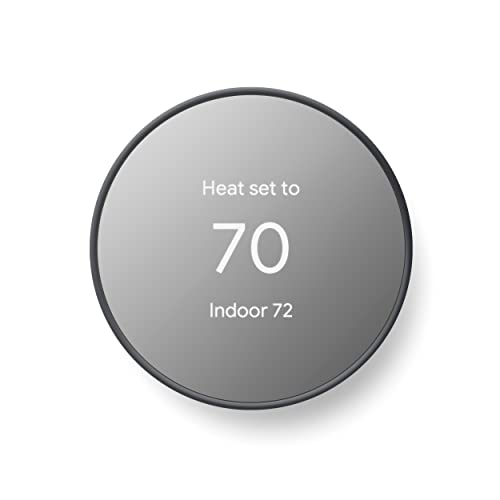
The Google Nest Thermostat is designed for people who want app-based control and some automation without moving to a more complex premium system. It supports scheduling through the Google Home app, and it can turn itself down when you leave so the HVAC system is not conditioning an empty home. For many users, that mix of convenience and energy awareness is the main reason to consider it. The compact design also gives it a cleaner look than many traditional thermostats.
It belongs in this guide because it solves a different problem from the basic programmable models. Instead of asking you to remember every schedule change, it can adjust around your routine and send alerts when the HVAC system appears to need attention. That can be useful for busy households or anyone who already uses Google smart home products. The main limitation is that it is most attractive when you actually want the app and ecosystem features. If you just need a wall timer for temperature changes, the added functionality may be more than you need.
Pros:
- Wi-Fi control through the Google Home app
- Can adjust settings when you leave home
- Works with Google Assistant and Matter-compatible voice platforms
- Offers HVAC monitoring and maintenance reminders
- Can work without a C-wire in many homes
Cons:
- Some systems still need a C-wire or power accessory
- Less ideal for users who want a very simple wall thermostat
The Nest Thermostat suits buyers who want smart scheduling and remote access in a compact package. It is especially sensible for people who already live inside the Google ecosystem.
Best for: Homes that want a smart thermostat with strong app control and automatic energy-saving behavior.
Google Nest Thermostat, Snow

The Snow version of the Google Nest Thermostat offers the same core functionality as the charcoal model, just in a lighter finish. It provides app-based scheduling, remote access, energy-saving behavior, and HVAC monitoring. That means the practical decision here is mostly about appearance and how the thermostat fits into the room. For some buyers, that matters more than it first seems, especially when the thermostat sits in a visible part of the home.
This model earns attention because it gives readers the same Nest feature set while offering a different look. It is a sensible option if you want the Nest platform but prefer a lighter color that blends into a brighter wall or a more neutral interior. The trade-off is price. Since the core experience is very similar to the charcoal version, the higher cost makes sense only if the finish is worth it to you. Otherwise, the charcoal model is usually the better value.
Pros:
- Same smart features as the charcoal Nest Thermostat
- Cleaner lighter finish may suit some interiors better
- App scheduling and remote control are easy to use
- Supports HVAC monitoring and energy-saving adjustments
- Works with major smart home platforms
Cons:
- More expensive than the charcoal version
- Color difference is the main practical distinction
The Snow model makes sense if you like the Nest experience and want a lighter visual finish. If appearance matters as much as function, it gives you that choice without changing the core smart features.
Best for: Buyers who want the Nest platform in a white finish and do not mind paying more for the color option.
ecobee Smart Thermostat Essential

The ecobee Smart Thermostat Essential is aimed at buyers who want a capable smart thermostat with broad ecosystem support. It works with Apple HomeKit, Google Assistant, and Alexa, so it fits into more setups than some single-platform models. The color touchscreen gives it a more modern feel, and the app lets you track energy use while adjusting schedules from elsewhere. For homes without a C-wire, ecobee offers the option of a Power Extender Kit sold separately, which can make installation more realistic in older homes.
It stands out because it combines smart home flexibility with practical energy tools instead of loading on features that many people never use. The optional SmartSensor support is helpful if some rooms run hotter or cooler than others, although the sensors are separate purchases. That makes this a better fit for readers who want a more thoughtful smart thermostat rather than the cheapest Wi-Fi option. It is not the least expensive model here, but its combination of compatibility, app support, and expansion options gives it a strong position in the category.
Pros:
- Works with Siri, Alexa, and Google Assistant
- Color touchscreen and app control are easy to use
- Optional SmartSensor support helps with room-by-room comfort
- Useful energy features like schedule assistant and humidity detection
- Can work in homes without a C-wire using a PEK
Cons:
- Higher upfront cost than basic thermostats
- PEK and SmartSensor accessories are sold separately
ecobee is a strong pick if you want a smart thermostat that can grow with your home. It is especially appealing when you value both platform compatibility and room-by-room comfort control.
Best for: Smart home users who want flexible compatibility and optional room sensor support.
Honeywell Home RTH9600WF Smart Color Thermostat
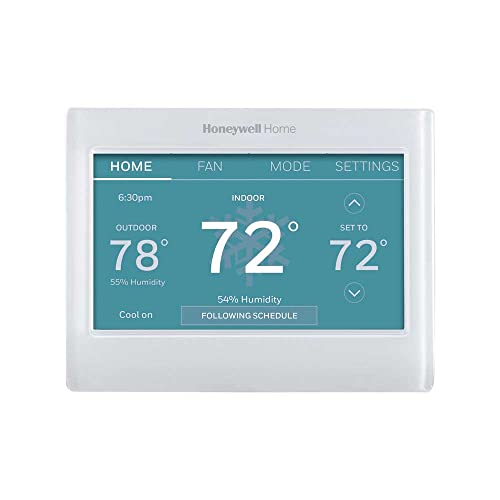
The Honeywell Home RTH9600WF is a feature-rich smart thermostat for homes that want more information on the screen and more control through the app. Its customizable color display is unusual in this category, and the home screen shows indoor and outdoor temperature, humidity, and forecast details. That can make it easier to check conditions quickly without opening an app. It also supports flexible programming, so it can work as either a smart device or a more traditional scheduled thermostat.
This model is worth considering if you want a premium-feeling interface and already have the wiring it needs. The C-wire requirement will rule it out for some homes, which is an important limitation rather than a minor note. But for compatible systems, it offers broad smart home support and a strong balance of convenience and information. It is more expensive than several other options in this guide, so its value depends on whether you will actually use the color screen, app control, and energy feedback.
Pros:
- Customizable color display
- Shows temperature, humidity, and forecast data on screen
- Works with multiple smart home platforms
- Flexible programming options for different routines
- ENERGY STAR certification
Cons:
- C-wire required
- More expensive than many other programmable options
RTH9600WF is best viewed as a premium smart thermostat for compatible systems. It offers a lot of useful information and a distinctive display, but it only makes sense if your wiring and budget match.
Best for: Homeowners with compatible wiring who want a premium smart thermostat with a color screen.
Amazon Smart Thermostat

The Amazon Smart Thermostat is built for households that already use Alexa or want a simple way to bring thermostat control into that ecosystem. It supports schedules, remote control through the Alexa app, and integration with selected Alexa devices for more coordinated comfort control. Because it uses Honeywell Home thermostat technology, it benefits from a familiar approach to core thermostat functions even though the software experience is tied closely to Amazon services.
It deserves a place in this roundup because it is a straightforward smart thermostat with a clear audience. If your home already relies on Alexa, it can feel more seamless than choosing a platform-neutral device and then layering Alexa on top. The trade-off is that it requires a C-wire, so installation is not as forgiving as some competing models. That makes it more suitable for homes that already know their wiring can support it or for buyers comfortable confirming compatibility before ordering.
Pros:
- Works well with Alexa and Ring ecosystems
- Remote control and scheduling through the Alexa app
- ENERGY STAR certified
- Can support comfort zones with select Alexa devices
- Backed by Honeywell Home thermostat technology
Cons:
- C-wire required
- Less appealing for non-Alexa households
This is a practical choice if you want a connected thermostat that fits naturally into an Alexa-based home. It keeps the experience simple, but the wiring requirement means it is not the easiest fit for every household.
Best for: Alexa users who want a budget-friendly smart thermostat with basic automation.
Sensi Lite Smart Thermostat

The Sensi Lite Smart Thermostat is the lower-cost sibling in the Sensi lineup, and it focuses on the features many buyers use most. You still get Wi-Fi control, app access, scheduling, geofencing, and energy reporting, but the overall package is leaner than premium smart models. For many homes, that is a good thing. It keeps the purchase more affordable while still offering the benefits that make smart thermostats useful in the first place.
It belongs here because it solves the common problem of wanting smart control without paying for extras you may never use. The privacy policy is also a practical selling point for readers who want to avoid data-sharing concerns. The main thing to keep in mind is system compatibility, since heat pump and heat/cool only systems may require a C-wire. If your system matches, this can be one of the more sensible value choices in the category.
Pros:
- Lower price than many other smart thermostats
- App control, scheduling, and geofencing included
- Privacy-focused approach
- Energy Star certified
- Simple DIY installation for many homes
Cons:
- Fewer advanced features than premium smart thermostats
- C-wire required for some system types
For shoppers who want a smart thermostat without adding too much cost or complexity, Sensi Lite is an easy model to consider. It covers the core jobs well and keeps the focus on value.
Best for: Budget-minded buyers who want smart features and a simple app experience.
Buying Guide: What to Look For in a Programmable Thermostat
The most important factor is system compatibility. Some thermostats work with single-stage forced air systems, while others support heat pumps, multi-stage systems, or hot water heat. If a thermostat does not match your equipment, the rest of its features do not matter. C-wire requirements matter too. Many smart thermostats can run without one in some homes, but not all systems are compatible. Before you buy, check the manufacturer’s compatibility tool and compare it with your current wiring.
After compatibility, think about how much control you actually want. A simple programmable thermostat is often enough if your schedule is predictable and you mostly want a lower bill through set temperature changes. A smart thermostat makes more sense if you travel, work irregular hours, or want remote access from your phone. Touchscreen controls, app reports, and voice assistant support can be useful, but only if you plan to use them. Otherwise, a simpler model may be easier to live with.
It is also worth considering how much maintenance help you want. Some thermostats provide filter reminders, humidity readings, or HVAC alerts. Those features do not replace regular system care, but they can make it easier to notice problems early. Finally, think about the room where the thermostat will be installed. A high-contrast screen, physical buttons, or simple scheduling may matter more in a busy hallway than in a tech-heavy smart home.
Common Mistakes Buyers Make
- Ignoring wiring requirements: This is one of the most common reasons a thermostat becomes a poor purchase.
- Choosing too much technology: Some households buy a smart model when a basic programmable one would be easier and cheaper to use.
- Overlooking system type: Heat pumps, baseboard heat, and multi-stage systems often need specific compatibility.
- Not thinking about routine: A 7-day schedule is useful for irregular weeks, but unnecessary for some homes.
- Forgetting about app dependence: If you dislike phone-based control, a smart thermostat may not feel simpler in daily use.
FAQ
Do programmable thermostats really save energy?
They can, especially when the schedule matches how you actually use the home. Lowering heating or cooling when you are away is more effective than constantly changing the temperature by hand.
Is a smart thermostat better than a programmable thermostat?
Not always. Smart thermostats add convenience, app access, and sometimes automation, but a basic programmable model can be a better fit if you want simplicity and lower cost.
Do I need a C-wire?
Some thermostats need one, especially certain smart models and certain system types. Others can work without one in many homes. Always check compatibility before buying.
Which thermostat is easiest to install?
Basic programmable thermostats are usually the simplest. Smart models can still be DIY-friendly, but compatibility checks matter more.
Final Recommendations
If you want a no-nonsense programmable thermostat, the Honeywell Home RTH20B is a practical place to start. If smart features matter more, Sensi, Nest, ecobee, Amazon, and Honeywell each offer different balances of app control, compatibility, and setup complexity. The best choice is the one that matches your HVAC system and your daily routine. That is usually more important than the longest feature list.