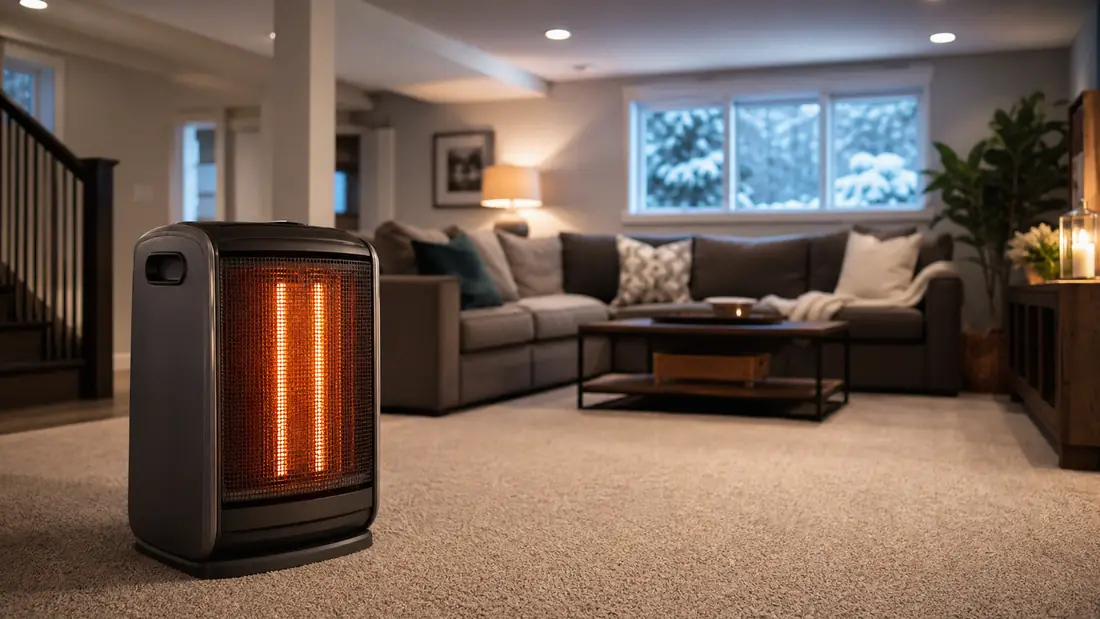
Basements usually need more than just raw heat. They tend to be cooler, more humid, and less evenly insulated than the rooms upstairs, which means the wrong heater can leave one corner warm and another still uncomfortable. The best infrared heater for basement use depends on how the space is built, whether you need portable or mounted heat, and how much floor space you are willing to give up.
Infrared heaters are a practical fit for many basements because they warm objects and people directly instead of relying only on heating the air. That can feel more efficient in a room that is partially finished, used only part of the day, or prone to cold spots. The options below include portable models, wall-mounted units, and heaters with added features such as thermostats, timers, and safety shutoffs. Each one serves a different basement setup, so it helps to compare them by layout and use case rather than assuming one model is right for every home.
Quick Answer
If you want a straightforward basement heater for regular use, a dual-heating portable model is often the most flexible choice. For a small finished basement or a room where floor space matters, a wall-mounted infrared heater can be more practical. If your basement runs especially dry in winter, a model with a built-in humidifier may also be worth considering.
Comparison Table
| Product | Type | Best Use | Key Trade-Off |
|---|---|---|---|
| Dr Infrared Heater DR-968 | Portable dual-heating | General basement use | Needs floor space |
| Heat Storm HS-1500-PHX-WIFI | Wall-mounted infrared | Finished basements, zone heating | Installation required |
| DR. Infrared Heater DR-998 | Portable with humidifier | Dry basements, comfort-focused use | More features than some buyers need |
| EdenPURE Classic CopperPLUS Infrared Heater | Portable large-room heater | Larger finished basements | Higher price |
| Ballu Mica Infrared Panel Space Heater | Smart panel heater | Quiet, controlled heating | More expensive than basic heaters |
| Amazon Basics Portable Space Heater | Budget portable heater | Smaller basements, occasional use | Less refined for larger spaces |
| Ballu Mica Infrared Space Heater | Portable or wall-mount panel | Flexible basement layouts | Wall mounting may not suit every room |
| DR. Infrared Heater DR-123 | Portable dual-heating | Bedrooms, offices, family rooms in basements | Less specialized for very large spaces |
How We Chose These Picks
Basements vary more than most rooms, so the list below is not a ranking from one to eight. Instead, each heater was chosen to solve a different basement problem, such as limited floor space, dry air, quiet operation, or more consistent zone heating. That makes it easier to match the heater to the space you actually have, rather than buying based on wattage alone.
Our Top Picks
Dr Infrared Heater DR-968 Portable Space Heater, 1500-Watt, Cherry

The DR-968 is a portable 1500-watt infrared and PTC hybrid heater, which makes it a strong fit for many basements that need steady supplemental warmth. It is designed to heat a large room, and the combination of infrared quartz tube and PTC heating is meant to deliver faster warmth than a basic single-element heater. The unit also includes a remote control, caster wheels, an electronic thermostat, and a 12-hour shutoff timer, so it works well in spaces where you want to set the heat and leave it alone for a while.
For basement use, the practical value here is balance. It is not tied to one room or installation style, and it can move from a finished family room to a workshop area if needed. The low-noise blower is another useful detail in a basement that doubles as living space. It is not the least expensive option on this list, and it does take up floor space, but it covers the needs of many homeowners who want a simple heater with more control than a bare-bones model.
Pros:
- Dual heating system provides more even warmth than a basic single-method heater
- Quiet operation is helpful in basement media rooms or offices
- Casters make it easy to move between rooms
- Remote control and timer improve day-to-day convenience
- Built-in safety features add peace of mind
Cons:
- Requires floor space, which may be an issue in smaller basements
- Not ideal if you want a fixed, wall-mounted setup
This is a practical all-around choice for basements that need dependable zone heating without a complicated setup. It fits especially well in finished spaces where quiet operation, portability, and straightforward controls matter more than advanced smart features.
Best for: Finished basements, family rooms, and flexible supplemental heating
Heat Storm HS-1500-PHX-WIFI Infrared Heater, Wifi Wall Mounted

This wall-mounted infrared heater is a good option when basement floor space is limited. Because it mounts to the wall, it stays out of the way and can be placed where it makes the most sense for zone heating. It offers 1500 watts of power, a digital thermostat, remote control, and Wi-Fi control from a phone, which gives it more convenience than many basic basement heaters. The cool-to-touch design is also useful in homes with kids or pets.
For a finished basement, this model makes a lot of sense if the room is used regularly and you want the heater to feel more like part of the space than a temporary appliance. It can heat small areas as a primary source and larger areas as supplemental heat, depending on insulation. The trade-off is that wall mounting is less convenient if your basement layout changes often or if you need to move heat from one side of the room to another. It is best viewed as a permanent zone heater rather than a portable solution.
Pros:
- Wall-mounted design saves valuable floor space
- Wi-Fi control adds convenient temperature management
- Cool-touch exterior improves everyday safety
- Good for clean-looking finished basements
- Can serve as zone heating in insulated spaces
Cons:
- Requires installation, so it is less flexible than a portable heater
- Not a good fit for unfinished basements with limited wall access
This is one of the better choices if you want basement heat that stays in place and does not get in the way. It is especially useful for rooms where furniture layout matters and a permanent mount is easier to live with than a portable heater.
Best for: Finished basements, wall-mount installations, and space-saving zone heating
DR. INFRARED HEATER DR-998, 1500W Dual Heating Infrared Space Heater with Humidifier, Oscillation, Remote Control, Thermostat & Safety Protection, Portable with Wheels, Energy Efficient, Cherry

The DR-998 combines infrared heating with a built-in cool-mist humidifier, which can be useful in basements that feel dry during the heating season. It also includes oscillation, a remote, a programmable thermostat, and tip-over and overheat protection. Like other dual-heating models, it is designed to warm people and objects directly, which can feel more comfortable in a basement than relying on hot air alone. The portable design and caster wheels make it easier to move from one basement area to another.
What sets this model apart is not just the heater itself, but the added humidity support. In a basement that is used as a den, office, or bedroom, dry winter air can become noticeable, especially when the heater runs often. This unit is more complex than a basic infrared heater, so buyers who want a simple appliance may not need the extra function. Still, for someone who wants warmth plus a little moisture management, it fills a practical niche.
Pros:
- Built-in humidifier helps address dry indoor air
- Oscillation can improve heat distribution in uneven rooms
- Portable design works well in multi-use basements
- Remote, timer, and thermostat add convenience
- No exposed heating elements, which is reassuring around children and pets
Cons:
- More features than some buyers will actually use
- Takes up floor space and is not wall-mounted
This model suits basement spaces where comfort means more than just temperature. If your lower level feels dry or uneven, the combination of heat, airflow, and added humidity can be more useful than a standard heater.
Best for: Dry basements, bedrooms, and multi-use family spaces
EdenPURE Classic CopperPLUS Infrared Heater

The EdenPURE Classic CopperPLUS is aimed at larger indoor spaces, which makes it worth considering for bigger finished basements. It uses 1500 watts of infrared heat with a copper core surface designed to transfer heat evenly and quietly. The company states that it can cover spaces up to 1000 square feet, although actual results will depend on insulation and layout. It also includes a digital thermostat, remote control, caster wheels, and cool-touch housing.
This heater belongs on the list because it is built for people who want a more substantial zone-heating option and do not mind paying more for it. The quieter operation and steady output can be appealing in a basement that functions as a living area, not just storage. The main drawback is cost. It sits well above the budget models, so it makes the most sense when you expect regular use and want a more refined heating experience.
Pros:
- Designed for larger finished basement areas
- Quiet operation suits living spaces and home offices
- Copper core design supports even heat transfer
- Cool-touch housing and overheat protection improve safety
- Portable enough to move between rooms
Cons:
- Higher price than many other infrared heaters
- Still dependent on room insulation for best results
If your basement is a true living space and you want a quieter, more polished heater, this model is a strong contender. It is less about bargain pricing and more about steady comfort in a larger room.
Best for: Larger finished basements, family rooms, and long daily use
Ballu Mica Infrared Panel Space Heater for Large Room, Smart Quiet Heater with Programmable Thermostat, WiFi App Control, Inverter Energy Efficient for Indoor Use, Compatible with Alexa, White

This Ballu panel heater takes a different approach from the portable box-style units on the list. It uses mica-based infrared heat in a slim panel design, with app control, Alexa compatibility, a programmable thermostat, and a wall-mount or freestanding setup. The company also emphasizes quiet operation and energy management, which may appeal to homeowners who plan to run heat in the basement often rather than only occasionally.
For basement use, the appeal is control and flexibility. The panel shape helps it blend into a finished room, and the smart features make it easier to schedule heat around a family routine. It is a better fit for readers who want a more modern setup and are willing to pay for convenience. The trade-off is that the app and smart functions are most useful when the room is used regularly. If you only need a heater a few times each winter, a simpler model may make more sense.
Pros:
- Slim panel design saves space and looks cleaner in finished rooms
- Smart app and voice control add scheduling convenience
- Quiet operation works well in bedrooms or offices
- Can be freestanding or wall-mounted
- Energy-focused controls may help reduce waste in regular use
Cons:
- Costs more than basic portable infrared heaters
- Smart features are unnecessary for some buyers
This is a good option for homeowners who want the basement heater to feel integrated into the room. It is especially sensible for finished lower levels where quiet operation and a tidy footprint matter.
Best for: Finished basements, smart-home users, and quiet zone heating
Amazon Basics Portable Space Heater with Remote Control, Adjustable Thermostat, Indoor Use, Energy-Saving Setting, LED Display, Classic Wood Casing, 1500W, Brown

The Amazon Basics portable heater is the budget-friendly entry on this list, and that matters if you only need modest basement heat from time to time. It offers 750-watt and 1500-watt settings, an ECO mode, an adjustable thermostat, a remote, and an overheat sensor. The wood-style casing gives it a more finished look than many low-cost heaters, though the overall design is still fairly simple.
For a small or medium basement, especially one used occasionally, this is a straightforward way to add warmth without spending much. It does not have the refined heating feel or room coverage of the higher-end models, but it gives buyers the basic controls most people need. If you are heating a rec room, storage area, or a corner workspace, the lower price may matter more than extra features. The main limitation is that it is better suited to smaller spaces and lighter use than to a larger basement that needs reliable all-day heating.
Pros:
- Low price compared with most other infrared heaters
- Remote control and thermostat make it easy to use
- ECO setting adds a basic energy-saving option
- Compact enough for smaller basement areas
- Simple controls are easy to understand
Cons:
- Less suitable for large basements
- Build and feature set are more basic than premium models
This heater makes the most sense when budget is the main concern and the basement does not need constant heat. It is a practical starter option for lighter-duty warmth.
Best for: Budget buyers, smaller basements, and occasional supplemental heat
Ballu Mica Infrared Space Heater Indoor Use, Large Room Panel Heater with Programmable Thermostat, WiFi App Control, Portable Stand or Wall Mount, Energy Efficient Smart Quiet Heater, Work with Alexa, White

This Ballu model offers many of the same strengths as the other panel heater on the list, but with a more flexible mounting approach. It can sit on casters or be wall-mounted, which gives it useful range for a basement that may change over time. The panel design, smart controls, and quiet operation make it appealing for finished spaces where comfort and appearance both matter. It also includes temperature control features that can help limit waste during regular use.
It deserves a place here because it suits basement owners who want a heater that can adapt to different layouts. A finished family room today may become a home office later, and a unit that can roll or mount offers more options than a fixed appliance. The downside is that this kind of flexibility comes at a higher price than entry-level heaters. If you do not plan to use smart scheduling or wall mounting, the extra features may not be worth it.
Pros:
- Can be used freestanding or wall-mounted
- Quiet panel design works well in living spaces
- Wi-Fi and Alexa support add scheduling convenience
- Good choice for finished basements with changing layouts
- Safety features and timer support everyday use
Cons:
- More expensive than basic portable heaters
- Smart features may be more than some users need
For a basement that needs a clean-looking heater with more placement options, this model is worth a close look. It works best when you value quiet, controlled warmth over a simple low-cost appliance.
Best for: Flexible basement layouts, wall mounting, and quiet daily use
DR. Infrared Heater DR-123 Indoor Portable Space Heater with Remote Control, 1500W Dual Heating, 4 Wheels for Mobility, Programmable Timer, Thermostat, Ultra Quiet, Coffee

The DR-123 is another portable dual-heating model, but it leans heavily into convenience. It has infrared quartz and PTC heating, four caster wheels, a remote, a programmable 12-hour timer, a digital thermostat, and multiple modes including Eco. The quiet operation is useful in basements that serve as a TV room, office, or guest area, where constant fan noise would be distracting.
This model stands out for buyers who want a practical everyday heater without unnecessary complexity. The lifetime filter is a nice maintenance feature, especially for a basement where dust can build up faster than in other parts of the house. It does overlap with some of the other portable heaters on the list, but the combination of quiet output, mobility, and lower-maintenance design gives it a clear role. If you need a heater you can move around often, this one deserves consideration.
Pros:
- Quiet enough for basement bedrooms and offices
- Wheels make it easy to move from room to room
- Eco mode and thermostat help with control
- Lifetime filter reduces routine upkeep
- Good mix of portability and comfort features
Cons:
- Portable design still takes up floor space
- Not as permanent a solution as a wall-mounted unit
This is a sensible choice if you want a quiet heater that can move around a basement with changing needs. It works well for people who care about convenience and low maintenance more than fixed installation.
Best for: Basement bedrooms, offices, and users who want an easy-to-move heater
Buying Guide
Choosing an infrared heater for a basement is easier when you focus on how the room is used. A finished basement used as a living area has different needs than an unfinished space used for storage or laundry. Start with the room layout, insulation level, and whether you want a heater that stays in one place or moves when needed.
Room Size and Insulation
Infrared heaters work best in spaces where you want to heat people and objects directly rather than trying to raise the temperature of every square foot. In a well-insulated basement, that can be very effective. In a drafty or partially finished basement, you may need a heater with stronger output or a model that includes a fan-assisted element to help distribute warmth more evenly.
Portable vs. Wall-Mounted
Portable heaters are better if you want flexibility or if the basement layout changes often. Wall-mounted units save floor space and can look cleaner in a finished room. If the basement is used as a permanent office, den, or guest room, a wall-mounted design may be more practical. If it is used for multiple purposes, portability is usually easier to live with.
Noise Level
Noise matters more in basements than many buyers expect. A heater in a TV room, bedroom, or office should run quietly enough that it does not become a distraction. Infrared heaters are often quieter than other space-heating styles, but some still use fans or blowers. If you are sensitive to background noise, pay close attention to that detail.
Safety Features
Tip-over protection, overheat shutoff, and cool-touch surfaces are important in any basement heater. These features matter even more if the room is used by children, pets, or guests. A basement may also have tighter furniture placement, so a heater with reliable safety controls is worth prioritizing over extra convenience features you may rarely use.
Energy Use
No infrared heater will replace central heating in every situation, but zone heating can help reduce waste by warming only the rooms you use. That makes them especially useful in basements that are occupied only part of the day. Look for thermostats, eco modes, or smart scheduling if you want more control over operating costs.
Common Mistakes
- Buying a heater based only on wattage without considering insulation or room shape
- Choosing a large portable model when floor space is already limited
- Ignoring noise if the basement doubles as a living room or office
- Skipping safety features in a room where furniture may sit close to the heater
- Assuming a heater made for a small room will handle a large, unfinished basement
FAQ
Are infrared heaters good for basements?
Yes, they can be a good fit for many basements because they warm people and objects directly. That makes them useful for zone heating in finished or partially finished spaces, especially when you do not want to heat the entire house.
Do I need a portable or wall-mounted basement heater?
Choose portable if you want flexibility or plan to move the heater around. Choose wall-mounted if the basement is finished and you want to save floor space. The better option depends on how permanent your setup is.
Can an infrared heater warm an unfinished basement?
It can help, but results depend heavily on insulation, air leaks, and room size. In an unfinished basement, heat loss is often higher, so a portable infrared heater may be useful for a work area or seated zone rather than the entire space.
What safety features matter most?
Tip-over protection, overheat shutoff, and a cool-touch exterior are the most useful features to look for. They help reduce risk in a room where the heater may run for long periods or sit near furniture.
Final Recommendations
If you want a versatile basement heater that works in many different setups, the Dr Infrared Heater DR-968 is a strong all-around pick. If floor space is tight, the Heat Storm wall-mounted unit is easier to live with. For dry basements, the DR-998 adds humidification, while the EdenPURE and Ballu panel heaters make more sense for larger finished spaces. Budget buyers can start with the Amazon Basics model, and anyone who wants a quiet, movable heater should also look closely at the DR-123.