Choosing the best space heater for office use usually comes down to a few practical questions: how large the room is, whether you want heat aimed at your desk or spread across the space, how much noise you can tolerate, and which safety features matter most in a shared work area. A good office heater should warm quickly without being distracting, fit on or under a desk when needed, and offer controls that are easy to adjust during the workday.
This guide focuses on portable electric heaters that suit different office setups. Some are better for a personal workspace, while others are more useful in small shared offices or rooms where even heat coverage matters. You will also see differences in oscillation, thermostat control, timer settings, and noise level, all of which can make a real difference during long work hours.
Quick Answer
If you want a straightforward choice for office heating, look for a compact 1500W ceramic space heater with a thermostat, tip-over protection, and low noise output. For a personal desk setup, simpler models can be enough. For a larger office or a room with uneven warmth, oscillation and finer temperature control are worth paying for. The options below cover budget, quiet operation, portability, and better heat distribution.
Quick Comparison
| Product | Best For | Notable Strength |
|---|---|---|
| DREO Space Heater with Remote | Balanced office use | Quiet operation with precise thermostat control |
| GiveBest Portable Electric Space Heater | Budget-minded users | Simple controls and useful dual heat settings |
| JIBUFI Small Portable Space Heater | Better heat spread | 70° oscillation and remote control |
| DREO 1500W Portable Electric Heater | Quiet shared offices | Wide oscillation with low noise output |
| WINHL Small Portable Electric Heater | Convenience-focused buyers | Remote control and oscillation in a compact design |
| DREO 1500W Heater with Tilt | Desk or floor placement | Adjustable tilt for aimed warmth |
| BLACK+DECKER Personal Ceramic Heater | Personal desk heat | Very simple and lightweight |
| Amazon Basics Ceramic Space Heater | Low-cost basic heating | Compact size and straightforward controls |
How We Chose These Picks
The heaters below were selected to serve different office needs rather than to crown one universal winner. Some are better for a small personal workspace, while others are more useful when you want heat to reach farther or spread more evenly. We also looked at practical office concerns such as noise, portability, temperature control, timer functions, and safety features that matter around desks, cords, and limited floor space.
Our Top Picks
DREO Space Heater, Portable Electric Heaters for Indoor Use with Thermostat and Remote

This DREO model is a strong fit for office use because it combines fast PTC heating with a thermostat that can be set in small increments. That makes it easier to keep a work area comfortable without constant adjustments. The 12-hour timer, remote control, child lock, and mute function add convenience in a setting where you may want to set the heater and leave it alone for long stretches. At 1500W, it is powerful enough for personal spaces and smaller offices, while the claimed low noise level is important if the heater will run near calls or focused work.
Compared with basic desk heaters, this one offers more control and a more polished feature set. It is especially useful if you want a heater that can stay in place on a floor or nearby surface and handle day-to-day office use with less fiddling. The trade-off is price, since it costs more than simpler compact models. Still, the combination of quiet operation, accurate temperature settings, and safety features makes it one of the more practical all-around choices for a shared or private office.
Pros:
- Precise thermostat control with 1-degree adjustments
- Quiet enough for work environments that need low distraction
- Remote control and timer add convenience during long office days
- Multiple modes, including ECO and fan-only
- ETL-listed safety features, including tip-over and overheat protection
Cons:
- Some users may not need the extra settings for a very small workspace
- Best suited to a nearby heating setup rather than heating an entire room
If you want a refined office heater with good controls and low noise, this is one of the stronger options in the group. It makes the most sense when comfort, convenience, and safety matter more than keeping the purchase price as low as possible.
Best for: Offices where quiet operation and easy temperature control matter most.
GiveBest Portable Electric Space Heater

The GiveBest heater is a practical budget option for a small office, cubicle, or desk-side setup. It uses ceramic heating with two heat settings, plus a fan-only mode for milder weather. The automatic thermostat helps reduce the need for constant manual adjustments, which is useful when you want a simple heater that can cycle on and off to hold a steady temperature. Its compact size and carry handle also make it easy to move from room to room.
This model stands out because it keeps the essentials simple while still covering the basics that matter in an office: fast heat, thermostat control, and safety shutoff features. It does not have the more advanced controls of some pricier heaters, but that is part of the appeal for buyers who want a no-frills option. If your office is small and you mainly need a personal warm zone near your desk, this heater offers solid value without taking up much space.
Pros:
- Low price for a heater with thermostat control
- Compact and easy to move
- Quiet enough for many office and work-from-home setups
- Two heat levels plus fan-only mode
- Built-in overheat and tip-over protection
Cons:
- Best for small to medium spaces rather than larger rooms
- Manual controls may feel basic for some users
This is a sensible pick for buyers who want dependable office warmth without paying for extra features they may not use. It is not the most advanced heater here, but it covers the core job well.
Best for: Budget-conscious buyers who want a simple heater for a small office or desk area.
JIBUFI Small Portable Space Heater for Indoor Use

The JIBUFI heater is a good choice when you want heat to spread beyond one fixed spot. Its 70-degree oscillation helps distribute warmth more evenly across a desk area or small office, which can be helpful if you move around during the day or share the space with someone else. It also includes multiple heat modes, ECO mode, and a remote control, so it is built for users who want a little more flexibility than a basic desktop heater provides. The compact form keeps it portable without making it feel oversized for office use.
What makes it useful in this category is the balance between coverage and convenience. Many small heaters warm one narrow area well but leave the rest of the room uneven. This model tries to address that with oscillation and a fuller set of controls. The trade-off is that the remote requires batteries, and the heater is still best for small to medium rooms rather than open offices. Even so, it is a sensible pick for people who want more even comfort near a workstation.
Pros:
- 70-degree oscillation improves heat coverage
- ECO mode can help reduce unnecessary energy use
- Remote control adds convenience
- Multiple heat and fan settings
- ETL certification and safety protections
Cons:
- Not intended to heat a large office by itself
- Some buyers may prefer a simpler non-oscillating design for desk use
If your office comfort problem is uneven heat rather than lack of raw power, this heater is worth considering. It is especially helpful when you want a more evenly warmed personal area without stepping up to a larger unit.
Best for: Small offices and shared work areas where wider heat coverage matters.
DREO Space Heater, 1500W Portable Electric Heaters for Indoor Use

This DREO model is aimed at buyers who want a quieter office heater with a broader reach. It uses 70-degree oscillation, which helps push warm air across more of the room than a fixed-direction unit. The digital thermostat, ECO mode, timer, and remote control make it easy to use throughout the workday, while the brushless DC motor is designed to keep noise low. Those details matter in an office, especially if the heater will run near meetings, phone calls, or concentrated work.
It earns a place here because it offers a more comfortable balance of circulation, control, and low sound than many basic portable heaters. The design is still compact, so it works best in personal offices and smaller shared rooms rather than large open spaces. The price is higher than entry-level models, but the added oscillation and quieter operation can be worth it if noise and even heating are top concerns. For many office setups, that combination is more useful than simply choosing the cheapest heater available.
Pros:
- 70-degree oscillation helps spread heat more evenly
- Quiet operation suits office environments
- Remote control and timer improve daily convenience
- ECO mode can reduce unnecessary heating
- ETL-listed safety protections
Cons:
- May be more than needed for a very small personal desk area
- Still best for localized room heating, not whole-floor heating
This is a well-rounded option for office users who want quiet performance and broader warmth without moving up to a much larger heater. It is especially practical when comfort has to coexist with a work setting.
Best for: Quiet offices and workspaces where oscillation and low noise both matter.
WINHL Small Portable Electric Heater

The WINHL heater is another compact option that focuses on convenience features suited to office use. It includes a thermostat, remote control, 70-degree oscillation, and a 12-hour timer, which makes it easy to leave on for a work session without constant monitoring. The PTC ceramic heating element is designed for quick warmth, and the oscillation helps avoid the narrow heat pattern that some smaller heaters create. That combination makes it more adaptable than a very basic personal heater.
This model is a good fit for readers who want practical controls without stepping up to a larger tower-style heater. The biggest advantage is the combination of remote access and oscillation at a moderate price point. It is still intended for small spaces, so it should not be expected to warm a big office on its own. Even so, it can be a sensible middle-ground choice for users who want added convenience and even heat distribution at a fairly approachable price.
Pros:
- Remote control and timer improve day-to-day usability
- Oscillation helps distribute heat more evenly
- Compact size works well near a desk or under a table
- Multiple modes support different comfort needs
- Built-in overheat and tip-over protection
Cons:
- Not ideal for larger offices or open-plan spaces
- Less recognizable brand support than some major names
This heater makes sense if you want a feature set that feels a little more complete than the lowest-cost models but still want to keep the unit compact. It is a balanced option for everyday office heating.
Best for: Office users who want remote control, oscillation, and a compact footprint.
DREO Space Heater 1500W with Adjustable Tilt

This DREO heater is designed for people who want warmth aimed more precisely at their body or workspace. The adjustable tilt lets you direct heat upward or forward, which can be useful if you keep the heater on the floor and want warmth reaching your legs and torso, or if you place it on a sturdy surface and need the airflow aimed in a particular direction. It also includes a thermostat, remote control, three heat settings, and three fan settings, giving it a wider range of use than a very simple heater.
Compared with oscillating models, this one is more about targeted comfort than broad room coverage. That makes it a strong fit for offices where you mostly care about warming one person’s area efficiently. The quiet operation is another advantage in a work setting. The trade-off is that it does not rely on oscillation to spread heat across the room, so it is less useful if you need to warm multiple people at once. For focused desk heat, though, the adjustable tilt is a practical feature that can be genuinely helpful.
Pros:
- Adjustable tilt helps direct heat where it is needed most
- Quiet operation suits office and desk use
- Remote control adds convenience
- Thermostat and multiple modes offer flexibility
- Compact and easy to reposition
Cons:
- Higher price than some basic personal heaters
- Tilt is helpful for targeting, but not a substitute for room-wide coverage
If your office heating problem is more about directing warmth than filling a room, this is one of the more practical choices. It is a focused solution for desk-level comfort.
Best for: Users who want heat aimed at a specific sitting or desk position.
BLACK+DECKER Personal Ceramic Heater

The BLACK+DECKER personal ceramic heater is aimed at straightforward desk-side warmth. It is compact, lightweight, and easy to carry, which makes it useful if you move between rooms or only need heat for a small personal area. The fan-only setting gives it some year-round flexibility, while the low and high heat settings make it easy to match the output to your comfort level. For a basic office heater, the controls are simple enough that most people can use it without much setup.
This model deserves attention because it covers the essentials without adding complexity. If you do not need oscillation, a digital display, or a remote, this kind of heater can be easier to live with in a small office. It is not intended for larger shared rooms, and the manual controls are more limited than some newer models, but that simplicity can be an advantage for people who just want a small heater near their desk. It is a practical pick for personal use rather than broad room heating.
Pros:
- Lightweight and easy to move
- Simple controls are easy to understand
- Compact enough for a desk-side setup
- Tip-over and overheat shutoff protection
- Fan-only mode adds a little versatility
Cons:
- Less feature-rich than many newer office heaters
- Best only for small personal spaces
This is a sensible choice if you want a basic office heater and do not need advanced settings. It is more about convenience and simplicity than extra features.
Best for: Personal desks, cubicles, and other very small work areas.
Amazon Basics Ceramic Space Heater

The Amazon Basics ceramic space heater is a no-nonsense option for buyers who want a compact heater with the core features covered. It offers high, low, and fan-only settings, plus tip-over and overheat protection. The unit is small and easy to move, so it works well in an office where you may need to shift it between a desk, side table, or nearby floor area. At 43 dB, it is also quiet enough for many work environments, which helps if you are sensitive to background noise.
It stands out mainly because it keeps the formula simple and affordable. There is no oscillation, so it is better for warming one person or one direction rather than distributing heat across the room. That makes it less versatile than some of the more advanced picks, but also easier to place and use. If you want a basic heater that focuses on portability, quiet operation, and low cost, it is a reasonable office choice, especially for smaller workspaces.
Pros:
- Affordable and straightforward
- Compact size is easy to fit into small offices
- Quiet enough for regular work use
- Three settings offer basic flexibility
- Built-in safety protections
Cons:
- Less adaptable than remote-controlled models
- Not intended for humid rooms
This heater is a solid fit for readers who want a basic office warmer without paying for advanced controls. It is a practical, low-complexity choice for personal use.
Best for: Shoppers who want a compact, low-cost heater for a small office.
What to Look for in an Office Space Heater
The best office heater for one person is not always the best one for a shared workspace. A heater aimed at a desk can be smaller and simpler, while a heater for a room with multiple workstations may need oscillation or stronger airflow. Noise matters too, since even a heater with good output can become distracting during calls or concentration-heavy tasks.
Safety should stay near the top of the list. Tip-over protection, overheat shutoff, and flame-retardant materials are important in offices where cords, chairs, and foot traffic create extra risk. It also helps to look for a thermostat and ECO mode if you expect to run the heater often, since those features can make temperature control easier and may reduce wasted energy.
Room size and placement
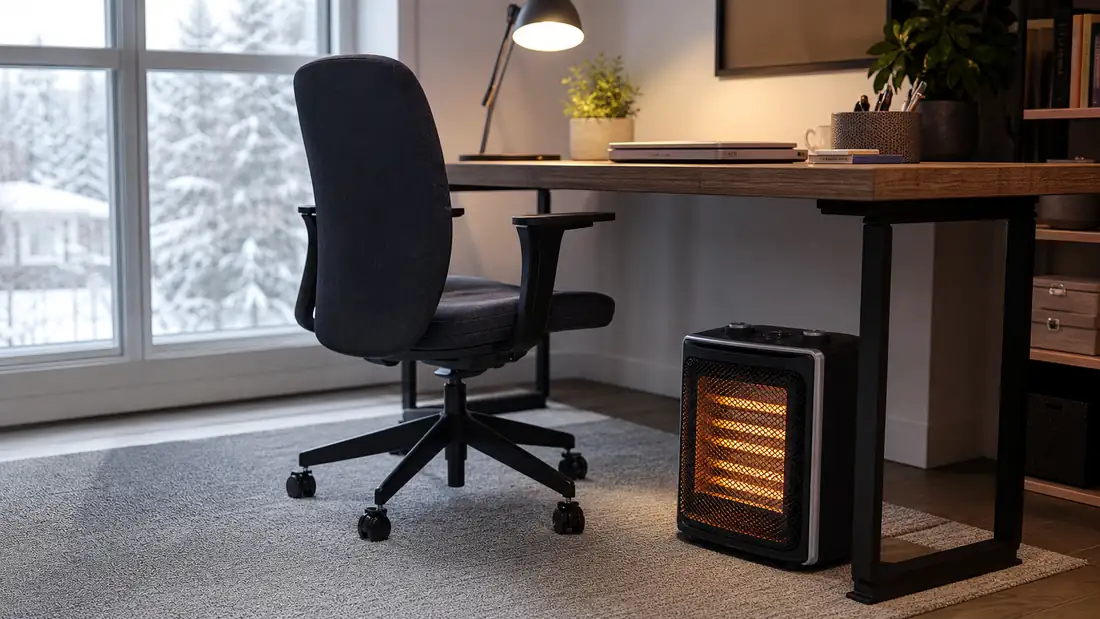
Small personal offices usually do fine with a compact 750W to 1500W ceramic heater. Larger rooms may benefit from oscillation or stronger fan circulation. If your heater will sit under a desk, check for safe clearance and make sure airflow is not blocked by papers, bags, or furniture.
Noise level
For office work, quieter heaters are usually easier to live with. A low-noise model is especially useful if you take calls, record audio, or work in an open office. If noise is not a concern, you may be able to save money with a simpler heater.
Controls and convenience
Remote controls, timers, and digital thermostats are helpful in office settings because they reduce interruptions. If you often adjust the heater throughout the day, those features can be more useful than raw heating power alone.
Common Mistakes to Avoid
- Choosing a heater that is too large for a personal workspace.
- Ignoring noise ratings when the heater will run near meetings or calls.
- Using the heater with an extension cord or power strip when the manufacturer advises against it.
- Assuming oscillation is necessary when a simple directed heater may be enough.
- Placing the heater too close to paper, fabric, or other office items.
Frequently Asked Questions
What size space heater is best for an office?
For most small offices and desk areas, a compact 1500W ceramic heater is a practical starting point. Smaller spaces may not need maximum output all the time, so a model with low and high settings gives you more flexibility.
Are office space heaters safe to use every day?
They can be safe when used as directed, but daily use should come with the usual precautions. Look for tip-over protection, overheat shutoff, and a stable placement on a flat surface. Also keep clear space around the heater.
Is oscillation important for office heaters?
Not always. Oscillation helps spread heat more evenly, which is useful in shared offices or slightly larger rooms. If you only want warmth for one desk, a non-oscillating heater may be enough.
Do quiet heaters heat less effectively?
Not necessarily. Many quieter office heaters use improved fans or motors to reduce noise while still providing useful warmth. Quiet operation and strong heating can coexist, but the more refined models usually cost more.
Final Recommendations
For most office shoppers, the right choice comes down to how you use the space. If you want a balanced heater with strong controls and quiet operation, the DREO model with remote control is a practical place to start. If price matters most, the GiveBest and Amazon Basics heaters cover the basics well. If you need broader heat coverage or a little more convenience, the oscillating models from JIBUFI, WINHL, and DREO offer more flexibility. For tightly focused desk comfort, the BLACK+DECKER and tilt-adjustable DREO are easier to position where you need them.