A work jacket has to do more than look appropriate on the job. It needs to allow comfortable movement, withstand routine wear, accommodate the right layers, and provide weather protection suited to the workplace. A jacket designed for a climate-controlled office will be very different from one intended for roadside work in cold rain.
This guide compares eight jackets for outdoor trades, warehouses, service work, commuting, and business-casual offices. The selections are not interchangeable. Some prioritize warmth and visibility, while others favor mobility, easy layering, or a polished appearance.
Quick Answer
The Dickies Lined Eisenhower Jacket offers a practical balance of warmth, workwear durability, and easy-care construction for general use in cool conditions. The Carhartt Rain Defender Relaxed Fit Jacket is better suited to active work where stretch, moisture management, wind resistance, and protection from light precipitation matter.
For jobs requiring high visibility, the TICONN Waterproof Safety Bomber Jacket combines an ANSI Class 3 design with a coated shell and fleece insulation. Workers who prefer a lighter utility jacket should consider the Red Kap Performance Crew Jacket or unlined Dickies Eisenhower. For an office, the Cicy Bell blazer provides a more appropriate business-casual appearance than traditional workwear.
Work Jacket Comparison
| Product | Best For | Material or Insulation | Weather Protection | Layering and Fit | Notable Trade-Off |
|---|---|---|---|---|---|
| Dickies Unlined Eisenhower | Mild weather and indoor work | Cotton-polyester twill, unlined | Limited cold-weather protection | Works well over light layers | Not insulated for winter cold |
| Dickies Lined Eisenhower | General work in cool weather | Poly-cotton twill with lining | Water-repellent construction | Adjustable waist tabs | Less protective than a dedicated rain jacket |
| Carhartt Rain Defender Jacket | Active outdoor work | Stretch fabric with moisture management | DWR finish and wind-resistant design | Relaxed fit supports movement | Not presented as a heavily insulated coat |
| HOTOUCH Women’s Bomber Jacket | Casual workplaces and mild seasons | Lightweight polyester | Minimal listed weather protection | Manufacturer advises sizing up | Not designed for rugged job sites |
| TICONN Safety Bomber Jacket | High-visibility work in wet, cold weather | Coated 300D polyester and fleece lining | Manufacturer describes it as waterproof and windproof | Elastic cuffs and waistband | May be too warm or bulky for active indoor work |
| Cicy Bell Women’s Casual Blazer | Business-casual offices | Soft, wrinkle-resistant fabric | No meaningful outdoor weather protection | Slim silhouette | Not protective workwear |
| KEFITEVD Quilted Bomber Jacket | Casual work and commuting | Polyester with quilted insulation | Listed as windproof and water-resistant | Midweight design with rib-knit edges | Less job-site focused than utility work jackets |
| Red Kap Performance Crew Jacket | Utility work and pocket organization | Stretch twill ripstop with quilt-lined pockets | DWR water-repellent finish | Lightweight construction supports mobility | Limited insulation for colder winter shifts |
How We Chose These Work Jackets
These recommendations were evaluated by intended workplace, construction, weather protection, mobility, pocket layout, layering potential, maintenance, and likely seasonal use. Manufacturer descriptions were used for material and performance details. No unsupported temperature ratings or first-hand testing claims have been added.
Durability matters, but it is only one part of choosing the best work jacket for work. A heavy jacket can become uncomfortable during strenuous activity, while an unlined design may require substantial layering in winter. Visibility requirements, rain exposure, uniform rules, and workplace hazards may also take priority over warmth or appearance.
Our Top Work Jacket Picks
The eight jackets below serve different workers rather than forming a simple best-to-worst ranking. Compare each garment’s intended setting, weather protection, insulation, and fit before deciding. A high-visibility winter jacket may suit a road crew but be unnecessarily bulky in a warehouse, while an office blazer provides no meaningful protection for physical or outdoor work.
Dickies Unlined Eisenhower Jacket

The unlined Dickies Eisenhower is a straightforward utility jacket made from cotton-polyester twill. Its lack of insulation keeps weight and bulk under control, making it more appropriate for mild days, indoor facilities, or active work where a lined coat would cause overheating. A double brass zipper provides a sturdy front closure, while welt hand pockets, a sleeve pencil pocket, and a hidden interior pocket provide basic storage without giving the jacket an overly technical appearance. Because it is unlined, its winter performance depends heavily on the layers worn underneath.
This version makes sense for mechanics, maintenance workers, delivery drivers, and others who move repeatedly between indoor and outdoor areas. It can also serve as an outer work layer over a sweatshirt in moderately cool conditions. Compared with the lined Eisenhower, it offers greater seasonal flexibility but noticeably less warmth. Buyers should compare garment measurements with the layers they plan to wear, particularly if they want to add a thick hoodie or midlayer.
Pros:
- Unlined construction reduces bulk during active work
- Cotton-polyester twill provides a traditional workwear feel
- Brass front zipper is suited to frequent use
- Interior, welt, and pencil pockets cover common storage needs
- Easy to combine with user-selected layers
Cons:
- Provides little standalone insulation for winter conditions
- Weather protection is limited compared with coated shells
- Thick layering may require additional fit consideration
This is the more adaptable Eisenhower option for mild climates, heated workspaces, and people who prefer to control warmth through layering. It is not the right choice for prolonged exposure to cold rain or low temperatures, but its uncomplicated construction makes it practical for routine indoor and transitional-season work.
Best for: Indoor trades, mild-weather job sites, mechanics, and workers who prefer an unlined outer layer.
Dickies Men’s Lined Eisenhower Jacket

The lined Eisenhower retains the familiar short work-jacket shape but adds lining for greater comfort in cool weather. Its poly-cotton twill fabric is described as wrinkle resistant and designed to retain its color, which can be useful when a uniform needs to remain presentable through regular wear. The manufacturer also describes the jacket as water repellent and water resistant. That should not be confused with a waterproof rain shell, but it can provide some protection from brief, light precipitation. Adjustable waist tabs help refine the fit, and the brass zipper is suitable for routine job-site use.
Slash front welt pockets and a left-sleeve pencil pocket keep the design functional without excessive external storage. The jacket is also described as compatible with industrial laundering, an important distinction for workers whose uniforms are cleaned through an employer or commercial service. It offers more standalone warmth than the unlined version while remaining less bulky than many insulated winter coats. The short hem supports mobility, although it leaves less coverage around the hips and upper legs.
Pros:
- Lining adds warmth for cool work environments
- Wrinkle-resistant twill is practical for uniform use
- Water-repellent finish helps with light precipitation
- Adjustable waist tabs allow some control over fit
- Industrial-laundry-friendly construction suits managed uniforms
Cons:
- Not a substitute for a waterproof work shell
- Short length provides less coverage than a parka
- May become warm during strenuous indoor activity
The lined Eisenhower offers one of the strongest balances in this group for general-purpose work. It provides moderate warmth, a professional workwear appearance, and uncomplicated maintenance. Workers facing heavy rain, high visibility requirements, or severe cold should choose more specialized protection, but this is a sensible option for garages, warehouses, service calls, and cool-weather commuting.
Best for: General work in cool conditions, uniforms, garages, warehouses, and service technicians.
Carhartt Men’s Rain Defender Relaxed Fit Jacket

This Carhartt jacket emphasizes movement and moisture control rather than heavy insulation. Rugged Flex stretch construction is intended to reduce restriction while bending, reaching, or handling materials. Its Rain Defender durable water-repellent treatment helps moisture bead on the surface during light precipitation, while Wind Fighter construction is designed to reduce wind penetration. The listed Carhartt Force fabric technology manages sweat, dries quickly, and controls odor, features that can be valuable during active shifts or changing weather. It also includes UPF 50+ sun protection for outdoor work.
The relaxed fit should provide more movement and layering room than a trim casual jacket, although buyers still need to check the manufacturer’s size chart. This model is most relevant for landscaping, property maintenance, equipment operation, and other jobs involving frequent movement. It differs from insulated bombers by managing variable conditions without concentrating solely on warmth. A worker in sustained winter cold may need a base layer and insulating midlayer beneath it, subject to fit and workplace safety requirements.
Pros:
- Stretch construction supports active movement
- DWR treatment helps repel light precipitation
- Wind-resistant design is useful in exposed workplaces
- Moisture-wicking and quick-drying properties suit physical work
- UPF 50+ protection adds value for outdoor shifts
Cons:
- Not listed as a fully waterproof rain jacket
- May require insulating layers in colder conditions
- Higher cost than several basic utility jackets
This Carhartt is the mobility-focused choice in the group. It favors stretch, wind resistance, and moisture management over thick insulation, making it better for active workers than for stationary cold-weather duty. Its value depends on whether those performance features are more important than maximum warmth or numerous tool pockets.
Best for: Landscaping, maintenance, construction support, and active outdoor work in variable weather.
HOTOUCH Women’s Lightweight Bomber Jacket

The HOTOUCH bomber is a lightweight polyester jacket intended primarily for casual use, commuting, school, and less formal workplaces. It has a zip front, long sleeves, and pockets, with styling that pairs easily with basic office-casual clothing. The manufacturer positions it for spring and fall rather than demanding winter weather. Its thin construction should be easier to carry and less likely to cause overheating indoors, but it does not provide the abrasion resistance, insulation, or specialized weather protection expected from job-site outerwear.
This jacket broadens the list beyond industrial settings. It may suit retail employees, teachers, office staff, or workers who need a light outer layer for the commute and an informal jacket during the day. The manufacturer notes that sizing runs small and suggests ordering up, but shoppers should still use the current size chart instead of relying on a general sizing rule. Anyone planning to wear a sweater underneath should account for that layer when selecting a size.
Pros:
- Lightweight polyester is easy to wear in mild conditions
- Bomber styling works in many casual workplaces
- Front pockets provide basic everyday storage
- Less bulky than an insulated work coat
- Suitable for commuting and indoor transitions
Cons:
- Not designed for rugged, abrasive, or hazardous work
- Provides limited warmth for winter outdoor use
- Buyers need to review sizing carefully
The HOTOUCH bomber is better understood as casual work clothing than protective workwear. It fills a useful role for mild commutes and relaxed indoor dress codes, but outdoor trades should choose a more durable, weather-resistant garment. Its main advantages are low bulk, simple styling, and compatibility with everyday clothing.
Best for: Retail, education, casual offices, commuting, and light use during spring or fall.
TICONN Waterproof High-Visibility Safety Bomber Jacket
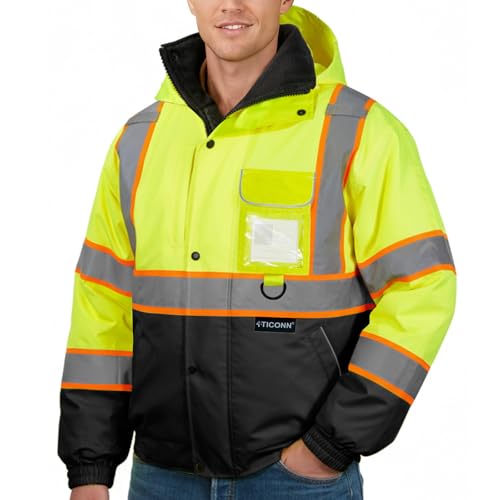
The TICONN safety bomber is designed for jobs where visibility and weather protection are central requirements. Its shell uses 300D Oxford polyester with a polyurethane coating, and the manufacturer describes the construction as waterproof and windproof. A 160-gram fleece lining supplies insulation, while elastic cuffs and a fitted waistband help reduce cold-air entry. The jacket is listed as meeting ANSI Class 3 high-visibility requirements and uses two-inch reflective striping to make the wearer more noticeable in low light.
Storage includes a zippered kangaroo pocket, chest pocket, transparent ID pocket, and a D-ring opening for small items. That arrangement may be useful for traffic control, surveying, sanitation, trucking, security, and railway work. This is more specialized than the other jackets in the guide, and its value depends on whether its visibility class satisfies the employer’s site-specific requirements. The coated shell and insulation may feel warm during high-output activity, so ventilation needs and shift conditions should be considered.
Pros:
- Listed ANSI Class 3 design supports high-visibility work
- Coated 300D polyester provides substantial weather protection
- Fleece lining adds warmth for cold shifts
- Reflective striping improves low-light visibility
- ID pocket and multiple storage points suit job-site use
Cons:
- Insulation and coated fabric may feel warm during strenuous activity
- Bomber length provides less lower-body coverage than a longer rain coat
- Workplace compliance should be confirmed with the employer
This jacket is the most appropriate choice here when high visibility is not optional. It combines insulation, a weather-resistant shell system, reflective material, and work-specific storage at a relatively accessible listed price. Workers should verify sizing, care instructions, and required safety classification before ordering rather than assuming any reflective jacket meets every job-site policy.
Best for: Road crews, surveyors, drivers, sanitation workers, security personnel, and low-light outdoor jobs.
Cicy Bell Women’s Casual Work Blazer

The Cicy Bell blazer addresses a different meaning of “work jacket.” It is designed for offices, meetings, and business-casual settings rather than physical labor or winter exposure. The soft fabric is described as wrinkle resistant, and the blazer uses a slim silhouette, lapel collar, one-button front, and two functional flap pockets. These features create a more polished appearance than a bomber or utility jacket while retaining enough versatility for casual outfits outside the office.
Its open neckline and fashion-oriented construction provide little protection from wind, rain, or cold. During winter, it works better as an indoor clothing layer under a separate insulated coat than as outdoor apparel. The manufacturer recommends machine washing in cold water, line drying, and avoiding bleach. Because slim cuts can leave limited room through the shoulders and torso, shoppers should compare the supplied measurements with both body dimensions and the tops they expect to wear underneath.
Pros:
- Business-casual styling suits offices and meetings
- Wrinkle-resistant fabric supports routine workplace wear
- Two functional pockets add modest storage
- Can be paired with dresses, trousers, or casual clothing
- Machine-washable according to the listed care guidance
Cons:
- Offers no meaningful winter weather protection
- Slim silhouette may limit layering room
- Not suitable for physical, industrial, or hazardous jobs
This blazer belongs in the guide for readers who mean professional office clothing rather than protective outerwear. It can provide structure and polish indoors, but winter commuters will still need a weather-appropriate coat over it. Careful measurement is especially important if it will be worn over sweaters or long-sleeve business clothing.
Best for: Business-casual offices, meetings, customer-facing work, and indoor professional settings.
KEFITEVD Men’s Quilted Bomber Work Jacket

The KEFITEVD bomber combines casual styling with quilted insulation and a polyester outer material. The manufacturer describes it as windproof and water-resistant, making it more weather capable than a basic fashion bomber, although water resistance should not be treated as waterproofing. Rib-knit cuffs, collar, and hem help limit drafts, while the midweight construction aims to add warmth without the bulk of a heavy coat. This balance is likely to work best in cool fall, mild winter, and early spring conditions.
Five exterior storage points include two zippered hand pockets, one additional zippered pocket, and two sleeve pencil pockets, with another pocket inside. This arrangement makes the jacket useful for commuting, delivery work, casual service jobs, and light-duty workplaces where small-item organization matters. The design is less specialized than a traditional utility jacket and does not include a visibility rating. The manufacturer also notes that the zipper pull is positioned on the left, a detail some buyers may need time to adjust to.
Pros:
- Quilted construction provides moderate insulation
- Rib-knit edges help reduce drafts
- Multiple zippered and pencil pockets organize small items
- Water-resistant material helps with brief light precipitation
- Midweight design is less cumbersome than a heavy winter coat
Cons:
- Not intended for sustained heavy rain
- Lacks specialized safety or industrial features
- Left-side zipper pull may feel unfamiliar to some wearers
The KEFITEVD bomber sits between casual outerwear and light workwear. It provides more warmth and storage than a thin fashion jacket, but it is not built around high visibility, industrial laundering, or severe weather. It makes the most sense for everyday work where comfort, moderate insulation, and a less formal appearance are priorities.
Best for: Commuting, delivery work, casual service jobs, and everyday use in cool weather.
Red Kap Men’s Performance Crew Jacket

The Red Kap Performance Crew Jacket uses lightweight stretch twill ripstop fabric, combining mobility with a work-oriented material. A durable water-repellent finish offers protection from light moisture, while a concealed solid brass zipper keeps the front appearance clean and helps shield the closure. The jacket includes two lower inset pockets with quilted lining, two inner chest pockets with concealed snap closures, and a utility pocket on the sleeve. This is one of the stronger pocket arrangements in the group.
Its relatively light construction is better suited to active work, indoor facilities, and shoulder seasons than stationary duty in deep winter cold. The stretch fabric should be useful when reaching or working around equipment, and the ripstop weave is intended to limit the spread of small tears. Compared with the Dickies Eisenhower jackets, this Red Kap places greater emphasis on concealed storage and lightweight movement. Workers needing more warmth can add layers, provided the selected size leaves enough room without creating loose fabric around machinery.
Pros:
- Stretch twill ripstop supports movement and routine wear
- DWR finish helps repel light moisture
- Multiple interior and exterior pockets improve organization
- Concealed brass zipper creates a tidy work-uniform appearance
- Lightweight construction is practical for active shifts
Cons:
- Provides limited standalone insulation for winter weather
- Water-repellent finish is not the same as waterproof construction
- Layering for cold conditions may require sizing adjustments
The Red Kap is a useful alternative to heavier work jackets when mobility and organized storage are more important than substantial insulation. It can function as a uniform layer in warehouses, shops, and service environments, or as a mild-weather outer jacket. Workers exposed to prolonged cold should pair it with suitable layers or select a warmer design.
Best for: Warehouse work, maintenance, repair shops, uniforms, and light outdoor duty.
How to Choose the Best Work Jacket for Your Job
Start With the Work Environment
Identify where most of the shift takes place. A heated warehouse generally calls for a light jacket that can be removed easily, while roadside or construction work may require insulation, wind protection, water resistance, and certified high visibility. Office employees usually need a presentable indoor layer and a separate winter coat for commuting.
Also consider how often the job moves between environments. Delivery drivers and service technicians may repeatedly leave a warm vehicle, making a moderately insulated jacket easier to manage than a heavy parka.
Match Insulation to Activity
More insulation is not always better. A stationary security worker may benefit from a fleece-lined jacket, while a worker carrying equipment or climbing ladders can quickly overheat in the same garment. Overheating produces moisture, and damp clothing can feel colder when activity stops.
For variable work, a layering system is often more flexible:
- Base layer: Manages moisture next to the skin.
- Midlayer: Adds adjustable insulation, such as a fleece or sweatshirt.
- Outer layer: Reduces exposure to wind and precipitation.
All layers should allow safe movement and should not create loose material around tools, equipment, or machinery.
Understand Weather-Protection Terms
Water resistant or water repellent generally indicates protection from light, brief moisture. A DWR finish encourages water to bead on the surface, but its effectiveness can diminish with dirt and wear. A product described as waterproof should use a barrier intended to prevent water penetration, although seams, closures, garment condition, and manufacturer instructions still affect real-world performance.
Wind resistance is equally important in exposed locations. Elastic or rib-knit cuffs, close-fitting hems, storm flaps, and higher collars can limit drafts. However, tighter closures can reduce ventilation during physical activity.
Leave Enough Room for Safe Layering
A work jacket should permit reaching overhead, bending, driving, and handling tools without pulling tightly across the shoulders. If winter layers will be worn underneath, take measurements while wearing a representative midlayer. Do not automatically size up without consulting the product chart because brands and garment cuts differ.
Extra room can support layering, but excessive fabric may snag around machinery. Workplace safety requirements should take precedence over a relaxed style preference.
Evaluate Pocket Placement
More pockets are useful only if they remain accessible while wearing gloves, a tool belt, or a safety harness. Interior pockets protect phones and documents, sleeve pockets keep pencils nearby, and secure closures reduce the risk of dropping items. Avoid loading pockets with heavy or sharp tools unless the garment is designed for that purpose.
Consider Care Requirements
Work jackets collect dust, oil, salt, and other contaminants. Check the care label before washing, especially with coated shells, reflective materials, and DWR-treated fabric. Some uniform jackets tolerate industrial laundering, while fashion blazers and coated safety garments may require gentler care.
Do not use bleach, fabric softener, high heat, or waterproofing treatments unless the manufacturer permits them. Improper care can damage reflective components, coatings, stretch fibers, or water-repellent finishes.
Common Work Jacket Buying Mistakes
- Choosing by warmth alone: A heavily insulated jacket can restrict movement or cause overheating during active work.
- Treating water resistance as waterproofing: A light DWR-treated jacket may not keep out sustained rain.
- Ignoring visibility rules: Bright colors and reflective strips do not automatically satisfy an employer’s required safety classification.
- Forgetting about layers: A jacket that fits over a T-shirt may become restrictive over a winter midlayer.
- Using casual clothing as protective equipment: Fashion bombers and blazers are not substitutes for garments required by a hazard assessment.
- Overlooking the care label: Heat, bleach, and inappropriate detergents can reduce garment performance.
- Assuming all work jackets fit alike: Short Eisenhower cuts, slim blazers, relaxed shells, and elastic-waist bombers fit very differently.
Frequently Asked Questions
What type of jacket is best for physical outdoor work?
A lightweight or moderately insulated jacket with stretch, wind resistance, and moisture management is often more comfortable for active work than a heavy coat. The Carhartt Rain Defender model is the most activity-focused option here. Colder conditions may require compatible base and midlayers rather than relying on one thick garment.
Is an Eisenhower jacket warm enough for winter?
That depends on the jacket, climate, exposure time, activity, and layers. An unlined Eisenhower offers little standalone insulation. A lined version is more appropriate for cool weather but is not equivalent to a heavily insulated winter coat. No specific temperature limit should be assumed without reliable manufacturer guidance.
Can a water-resistant work jacket be worn in heavy rain?
Water-resistant fabric is generally intended for limited moisture exposure, not prolonged heavy rain. Workers routinely exposed to wet weather should use an appropriate waterproof garment and confirm that it meets any relevant workplace visibility or protective-clothing requirements.
How should a winter work jacket fit?
It should allow a full range of motion while accommodating necessary layers. The cuffs and hem should control drafts without restricting circulation, and the jacket should not create loose material near machinery. Compare actual garment measurements and test the planned layering arrangement before workplace use.
Are high-visibility jackets required for outdoor work?
Requirements depend on the job, location, employer policy, and applicable regulations. Workers near traffic or moving equipment may need a specific visibility class. Confirm requirements with the employer or site safety manager rather than selecting a jacket based only on color or reflective appearance.
Which work jacket is best for an office?
For a business-casual office, the Cicy Bell blazer offers a more polished indoor appearance. The HOTOUCH bomber is better for relaxed dress codes. Neither provides substantial winter protection, so employees in cold climates may need a separate insulated commuting coat.
How often should a work jacket be washed?
Wash it when dirt, odor, contamination, or workplace policy makes cleaning necessary. Excessive washing can wear coatings and reflective components, while infrequent cleaning can reduce breathability and water repellency. Always follow the garment label and any employer rules for contaminated work clothing.
Final Recommendations
For general cool-weather work, the Dickies Lined Eisenhower provides a useful combination of moderate warmth, uncomplicated styling, and easy-care workwear construction. Choose the unlined version or the Red Kap Performance Crew Jacket when low bulk, movement, and layering flexibility matter more than insulation.
Active outdoor workers should give closer consideration to the Carhartt Rain Defender Jacket, while jobs involving traffic or low-light exposure may call for the specialized visibility and weather protection of the TICONN Safety Bomber. The KEFITEVD bomber is better suited to casual jobs and commuting. For indoor professional settings, the HOTOUCH bomber and Cicy Bell blazer address appearance rather than job-site protection.
Before ordering, check the size chart while accounting for planned layers, confirm the care instructions, and compare the jacket’s stated protection with actual workplace requirements. The most useful choice is the one that fits the job’s climate, activity level, hazards, and dress code without adding unnecessary bulk.