Choosing a heated vest involves more than counting heating panels. Battery runtime, heat placement, fabric, fit, and weather resistance all affect how useful a vest feels during a commute, a work shift, or a long day outdoors. A model with broad heating coverage may suit low-activity use, while a lighter fleece vest can be more comfortable for walking and layering.
The best heated vest for men should fit close enough for the heating elements to transfer warmth effectively without restricting movement. It should also match the conditions in which it will be worn. Heated vests add warmth around the core, but most are not substitutes for insulated, wind-blocking, or waterproof outerwear in severe winter weather.
Quick Answer
These eight heated vests address different budgets and uses. The ORORO Men’s Lightweight Heated Vest offers a balanced combination of insulation, weather resistance, and long low-setting runtime for everyday wear. The ORORO Heated Fleece Vest is a softer option for commuting and indoor use, while the Venustas Quilted Heated Vest provides broader heat coverage in a water-resistant nylon design.
Budget-focused shoppers can consider the Hotrego Heated Vest, which combines eight heating elements with independent controls. The DR.PREPARE Heated Vest costs less upfront and offers adjustable side zippers, but it does not include the required battery. Men seeking extensive heating coverage may prefer the Cosy Life 15-Zone Heated Vest, although its large battery is likely to be more noticeable during active use.
Heated Vest Comparison
| Product | Best For | Material and Protection | Heating Design | Notable Trade-Off |
|---|---|---|---|---|
| ORORO Lightweight Heated Vest | Balanced everyday use | Insulated, wind-resistant, and water-resistant | 4 zones, 3 settings | Higher price than many basic options |
| ORORO Heated Fleece Vest | Commuting and indoor wear | Soft lightweight fleece | 4 zones | Limited protection from wind and precipitation |
| Venustas Fleece Heated Vest | Broad upper-body heating | Breathable fleece | 6 panels, 3 settings | 20W charger is not included |
| Venustas Quilted Heated Vest | Light outdoor exposure | Water-resistant nylon | Broad collar, shoulder, back, and pocket coverage | Charger is not included |
| Hotrego Heated Vest | Independent heat control on a budget | Lightweight weather-protective fabric | 8 elements, 3 control zones | Manufacturer runtime is not clearly specified by setting |
| DR.PREPARE Heated Vest | Adjustable fit and existing battery owners | Filled vest with adjustable sides | 10 zones, separate front and back controls | Battery pack is sold separately |
| KOVNLO Fleece Heated Vest | Work, camping, and flexible control | Soft fleece with adjustable hem | 8 zones, 3 independently controlled sections | Listed runtime is 3 to 6 hours |
| Cosy Life 15-Zone Heated Vest | Extensive heat coverage | Windproof, water-resistant polyester | 15 zones, separate front and back controls | 20,000mAh battery adds weight and bulk |
Prices, availability, included accessories, and product specifications can change. Confirm the current listing, size chart, battery details, and care instructions before ordering.
How We Chose These Heated Vests
The recommendations were evaluated using manufacturer-provided information about heating coverage, battery capacity, fabric, controls, care, and included accessories. No personal testing is claimed. Because heating-zone counts do not follow a universal measurement standard, the number of zones should be treated as one comparison point rather than a direct measure of heating performance.
- Heating placement: Panels around the chest, upper back, collar, shoulders, and abdomen can warm different parts of the core. Placement is often more useful than a high zone count alone.
- Battery performance: Listed maximum runtimes generally apply to the lowest heat setting. High heat consumes power much faster.
- Fit and layering: A relatively close fit improves heat transfer, but there must still be room for comfortable movement and any intended base layer.
- Fabric and weather protection: Fleece emphasizes softness and breathability. Nylon or polyester shells generally provide better wind and light-precipitation protection, depending on their construction.
- Control flexibility: Independent heating sections can conserve battery power and reduce overheating when full coverage is unnecessary.
- Care requirements: A machine-washable label is useful, but batteries must be removed and the manufacturer’s drying instructions followed.
- Value: The initial price was considered alongside battery inclusion, control options, heating coverage, and likely versatility.
Our Top Picks
These products are not arranged as a simple best-to-worst ranking. Each fills a different role, including everyday commuting, soft fleece layering, adjustable sizing, broad heating coverage, and lower-cost use. Compare the fabric, battery arrangement, controls, and limitations against how long you expect to be outside and how active you will be.
ORORO Men’s Lightweight Heated Vest with Battery Pack
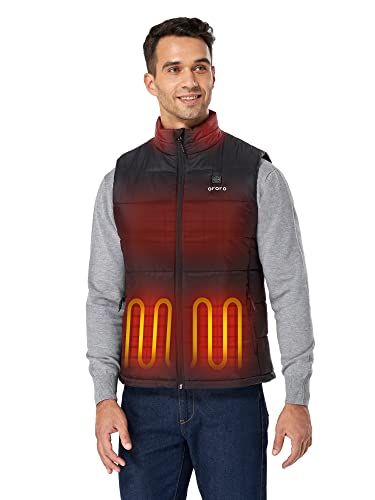
The ORORO Lightweight Heated Vest is a versatile insulated model intended for commuting, walking, spectator events, and use beneath a winter jacket. Its tailored construction is designed to preserve arm movement, while the wind-resistant and water-resistant exterior provides more protection than a typical fleece vest. Four carbon-fiber elements warm the collar, mid-back, and areas beneath the two front pockets. A single button cycles through three heat settings. According to ORORO, the included 7.4-volt battery heats quickly and can operate for up to 10 hours, though real runtime depends on the selected setting, ambient conditions, and battery age.
This is the most balanced everyday option in the group because it combines light insulation, basic weather resistance, and heating in areas that can warm both the torso and pocket regions. The battery also includes a USB port for charging a phone, although doing so will reduce the power available for heating. Its closer appearance may work well for casual or office settings, but buyers should check the size chart carefully and allow enough room for their intended base layer.
Pros:
- Four heating elements cover the collar, back, and front pocket areas
- Three heat settings allow straightforward adjustment
- Wind-resistant and water-resistant construction suits everyday winter exposure
- Manufacturer lists up to 10 hours of operation on a charge
- Battery and USB device-charging port are included
Cons:
- Costs more than several multi-zone alternatives
- Maximum runtime should not be expected when using medium or high heat
This ORORO vest offers a practical middle ground between a soft indoor layer and a more outdoor-oriented shell. Its four zones are less extensive than those on some competitors, but their placement and the vest’s weather-resistant construction make it a capable choice for varied everyday routines.
Best for: Men who want one heated vest for commuting, errands, dog walking, sporting events, and layering beneath a coat.
ORORO Men’s Heated Fleece Vest

The ORORO Heated Fleece Vest prioritizes softness and easy layering rather than substantial weather protection. Its lightweight fleece is suitable for a cool office, a daily commute, or casual outdoor use under a wind-blocking jacket. Four heating zones are positioned around the neck, back, and pocket areas, helping distribute warmth across the core and near the hands. The included 7.38-volt, 4,800mAh battery has a stated capacity of 35.424Wh. ORORO lists runtime at up to eight hours, with the usual qualification that higher settings, cold battery conditions, and battery aging can shorten operation.
Compared with ORORO’s insulated shell-style vest, this version should feel softer and less structured. That makes it easier to wear for long periods indoors, but fleece does not block wind as effectively as a protective outer fabric. It is therefore better viewed as a midlayer in windy or snowy conditions. The manufacturer states that the vest and its heating system are designed to withstand more than 50 machine-wash cycles. Buyers still need to remove the battery and follow all washing and drying directions.
Pros:
- Soft fleece construction suits extended everyday wear
- Lightweight design can fit beneath many winter jackets
- Heating reaches the neck, back, and pocket regions
- Battery is included and offers up to eight hours of listed runtime
- Machine-washable design simplifies routine care
Cons:
- Fleece provides limited wind and precipitation protection
- Four heating zones offer less coverage than several alternatives
The soft fabric and uncomplicated four-zone layout make this a sensible heated layer for moderate conditions. It is particularly useful when comfort and low bulk matter more than extensive weather protection. Pair it with an appropriate shell when wind, rain, or wet snow is expected.
Best for: Commuters, office workers, and casual users who prefer a soft fleece layer under a winter coat.
Venustas Men’s Fleece Heated Vest with Battery

The Venustas Fleece Heated Vest combines a soft, stand-collar fleece body with six carbon-fiber heating panels. Those panels cover the collar, chest, shoulders, and back, providing broader upper-torso coverage than the four-zone ORORO fleece design. Three heat settings are controlled with a button. The included compact battery has a stated capacity of 36Wh, with manufacturer-listed runtimes of up to 10 hours on low, six hours on medium, and three hours on high. These setting-specific estimates are helpful for planning, although actual results will vary with weather and use.
This model is well suited to men who want heat around both the chest and shoulders without moving to a shell-style vest. Fleece supports breathability and unrestricted arm movement, making the vest useful for walking, travel, and low-to-moderate activity. It can also be layered under a windproof jacket. The battery provides USB-A and USB-C outputs for charging devices and can be recharged in about 2.5 hours with a compatible 20W charger. That charger is not included, so shoppers should account for it if they do not already own one.
Pros:
- Six panels distribute heat across the chest, shoulders, collar, and back
- Soft fleece supports comfort and easy layering
- Runtime is specified for low, medium, and high settings
- Battery includes USB-A and USB-C outputs
- Machine-washable construction supports easier maintenance
Cons:
- Compatible 20W charger must be purchased separately if needed
- Fleece requires an outer shell in strong wind or wet weather
Venustas offers useful heating coverage without making this vest feel like heavy outerwear. It is a strong alternative to basic four-zone fleece models, especially for users who value chest and shoulder warmth. Its limited weather protection and separate charger requirement remain important considerations.
Best for: Men seeking a breathable fleece vest with broad upper-body heating for walking, travel, commuting, or indoor work.
Venustas Men’s Quilted Heated Vest with Battery
The Venustas Quilted Heated Vest uses a water-resistant nylon exterior rather than fleece, making it better suited to light outdoor exposure. Its stand-up collar adds coverage around the neck, while thin carbon-fiber panels warm the collar, shoulders, back, and pocket areas. Three settings allow the user to adjust output as activity and weather change. Venustas states that the included certified 36Wh battery provides up to 10 hours on low, six hours on medium, and three hours on high. A carry bag is included, but the charger is not.
This vest is a better match for errands, outdoor events, and light work where wind or occasional flurries are possible. The nylon exterior should resist light moisture better than fleece, but the product is described as water-resistant, not waterproof. It should not be relied upon as rainwear or sustained wet-snow protection. The heating layout emphasizes broad upper-body warmth, while the sleeveless construction leaves room for movement. Users expecting prolonged stationary time in severe cold will still need suitable base layers and insulated outerwear.
Pros:
- Water-resistant nylon exterior handles light precipitation better than fleece
- Heating covers the collar, shoulders, back, and pocket areas
- Three settings support changing activity levels
- Manufacturer provides runtime estimates for each setting
- Battery and carry bag are included
Cons:
- Charger is not included
- Water-resistant fabric is unsuitable for prolonged rain
This quilted Venustas model makes more sense than a fleece vest when light wind and precipitation are part of the day. Its broad heating coverage is useful for low-activity situations, but buyers should plan around the shorter high-setting runtime and provide a waterproof shell when conditions require one.
Best for: Everyday outdoor use, spectator events, commuting, and light work in cold conditions with occasional moisture.
Hotrego Heated Vest for Men with Battery Pack
The Hotrego Heated Vest provides eight carbon-fiber elements across the neck, shoulders, abdomen, back, and waist. These are divided into three independently controlled sections, allowing users to heat only the areas they need. Each section offers three levels, with manufacturer-listed settings of 113°F, 131°F, and 149°F. Those numbers describe element settings rather than guaranteed skin or body temperature. A light-off control mode makes the indicator less visible in a workplace, theater, or other setting where a bright illuminated button may be distracting.
Its lightweight V-neck design is intended for layering, and an adjustable hem helps bring the fabric closer to the torso. The included 10,000mAh, 5V battery weighs a listed 5.8 ounces and has a USB-C port, LED power display, and device-charging capability. The exterior is described by the manufacturer as waterproof and windproof, but shoppers should not assume seam-sealed rain protection without additional construction details. This vest’s combination of zoned controls and a relatively accessible price is appealing, although the listing does not provide clear setting-specific heating runtimes.
Pros:
- Eight elements cover the front, back, shoulders, neck, and waist
- Three independently controlled sections allow targeted heating
- Light-off mode provides less conspicuous operation
- Included battery has USB-C connectivity and a power display
- Adjustable hem can improve fit and heat transfer
Cons:
- Runtime by heat setting is not clearly specified
- Weatherproofing details should be confirmed before use in sustained precipitation
The Hotrego is a value-oriented choice for users who want more control over where the vest heats. Its independent zones can also help conserve battery power. Buyers who need predictable full-shift operation should clarify expected runtime and consider carrying a compatible backup power source.
Best for: Budget-conscious users who want independent heat zones for work, travel, outdoor events, or casual winter activities.
DR.PREPARE USB Electric Heated Vest
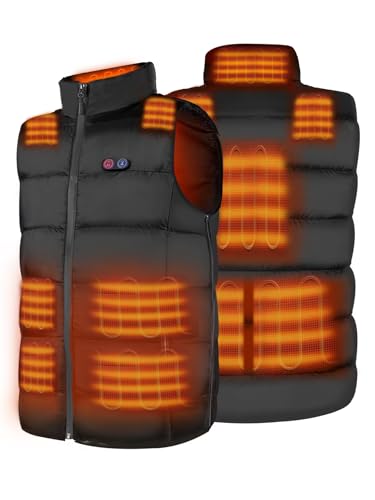
The DR.PREPARE Heated Vest takes a different approach to fit. Zippers on both sides provide up to 5.5 inches of total adjustment, which can help accommodate changing layers or small weight fluctuations. Its filled construction supplies passive insulation even before the power is switched on. Ten heating zones cover the abdomen, back, waist, neck, and shoulders, while two control buttons allow the front and back to operate separately. Three heat settings provide additional control over warmth and energy use.
The low purchase price needs context because the battery pack is not included. Buyers must obtain a compatible power source that meets the vest’s electrical requirements, and runtime will depend on that battery’s usable capacity. This arrangement can offer value to someone who already owns the correct battery, but it is less convenient for a first-time heated-clothing buyer. Adjustable sides also make the vest more adaptable than fixed-fit models, though sizing still needs attention because the listed version covers a limited base size range before adjustment.
Pros:
- Side zippers provide up to 5.5 inches of total fit adjustment
- Ten zones heat the front, back, waist, shoulders, and neck
- Separate front and back controls support targeted use
- Filled construction provides some warmth without battery power
- Both machine washing and hand washing are permitted under the care instructions
Cons:
- Battery pack is not included
- Total cost and runtime depend on the compatible battery selected
This DR.PREPARE vest is most attractive when adjustable sizing matters or when the buyer already owns a compatible power source. It is not the lowest-cost complete system once a battery is added, so first-time buyers should compare the full setup cost against kits that arrive ready to use.
Best for: Users who need flexible side sizing, change layers frequently, or already own a compatible battery pack.
KOVNLO Fleece Heated Vest for Men with Battery Pack
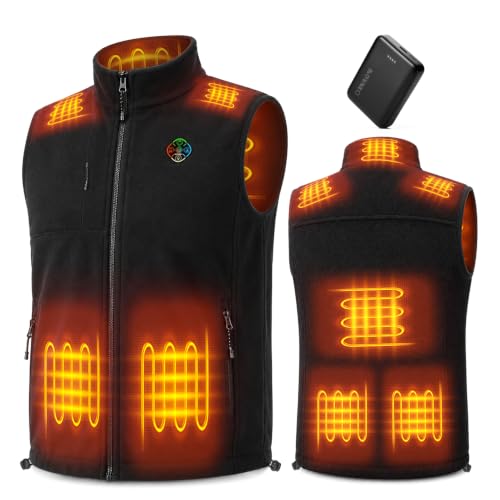
The KOVNLO Heated Vest pairs soft fleece with eight carbon-fiber heating zones across the neck, shoulders, abdomen, back, and waist. Three sections can be controlled independently, and each offers manufacturer-listed settings of 113°F, 131°F, and 149°F. The optional light-off mode helps keep the control display discreet. A high collar, adjustable hem, and two zippered pockets support practical everyday use, while the fleece body favors breathability and comfort over substantial weather protection.
Its included 10,000mAh battery has listed UL and CE certifications, a USB-C port, and protective features described by the manufacturer. Expected operation is three to six hours depending on the selected output, so this is not the longest-running option in the guide. Independent controls may extend useful runtime when only one area needs heat. The vest includes a laundry bag and can be machine washed after the battery is removed. For camping, hunting, or cold work, it functions best as a warming midlayer beneath a shell that blocks wind and moisture.
Pros:
- Eight zones provide front and back core coverage
- Three independent sections allow flexible heat management
- Soft fleece and adjustable hem support comfortable layering
- Battery pack, laundry bag, and user manual are included
- USB-C output can charge a phone in an emergency
Cons:
- Three-to-six-hour listed runtime is shorter than several competitors
- Fleece offers limited defense against wind and precipitation
The KOVNLO suits users who value independent controls and soft fleece more than maximum runtime. Its included kit and adjustable hem make it convenient, but a backup battery or access to charging may be necessary for long workdays or extended outdoor outings.
Best for: Shorter work periods, camping, fishing, riding, and other activities where targeted heat control is useful.
Cosy Life 15-Zone Heated Vest for Men
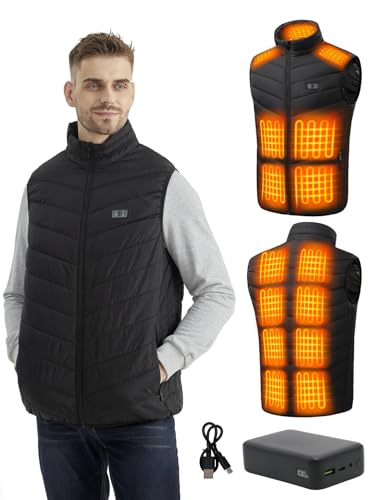
The Cosy Life Heated Vest emphasizes coverage and battery capacity. Fifteen carbon-fiber zones extend across the front and back, and separate controllers allow those areas to be adjusted independently. The three listed settings are 100°F, 113°F, and 131°F, which are lower at the top end than the stated settings of several competing models. Its polyester exterior is described as windproof and water-resistant, and the stand collar and zippered pockets add protection for casual outdoor use. Water resistance remains suitable for limited exposure rather than prolonged rain.
A 20,000mAh, 7.4-volt battery is included, with manufacturer-listed runtime of up to 11 hours. It provides USB and USB-C outputs plus 18W device charging. The large capacity is helpful for long outings, but capacity also has a physical cost. A 20,000mAh pack will generally be more noticeable in a pocket than the compact batteries included with many other vests. This trade-off matters during hiking, golf, and active work, where an uneven load can affect comfort. The vest is machine washable after the battery is removed and the connection is protected.
Pros:
- Fifteen zones provide extensive front and back coverage
- Independent controllers allow separate adjustment of chest and back heat
- Large-capacity battery offers up to 11 hours of listed operation
- Windproof and water-resistant polyester adds everyday weather protection
- USB and USB-C outputs support device charging
Cons:
- Large battery is likely to feel heavier and bulkier than compact alternatives
- Water-resistant construction is not intended as full rain protection
This model is most compelling for buyers who prioritize broad heating and long listed runtime. The trade-off is the weight and size of its battery. It may suit stationary or low-output outdoor use better than fast hiking or other activities where minimal pocket weight is important.
Best for: Hunting, fishing, spectator events, commuting, and long low-activity periods that benefit from extensive heating coverage.
How to Choose a Heated Vest for Men
Start With the Intended Activity
A commuter and a hunter may need very different vests. Commuting often favors a trim, lightweight garment that fits beneath a coat and does not feel awkward indoors. Hunting, fishing, and spectator events involve longer stationary periods, making broad heat coverage and battery capacity more important.
High-output activities such as brisk hiking can generate considerable body heat. A heavily insulated or continuously heated vest may cause sweating, which can make the wearer feel colder after slowing down. For active use, prioritize breathability, low weight, independent heat controls, and easy access to the power button.
- Commuting and errands: Look for low bulk, a clean fit, and at least basic wind resistance.
- Outdoor work: Consider battery runtime, pocket placement, durable fabric, and controls that can be used with gloves.
- Hunting and fishing: Broad front-and-back coverage is useful during long stationary periods.
- Hiking: Choose breathable fabric and use heat mainly during stops or low-output sections.
- Sporting events: A high collar, heated pocket areas, and a larger battery can improve comfort while sitting.
- Indoor work: Soft fleece and a discreet light-off mode may matter more than water resistance.
Consider Heat Placement, Not Just Zone Count
Manufacturers use different methods to describe heating zones. One large panel may warm more useful surface area than several small elements. There is no universal standard that makes a 15-zone vest automatically warmer than a four-zone design.
For general core warmth, look for elements on the upper or mid-back and chest. Collar panels can help people who dislike cold around the neck, while abdomen and waist panels are useful during stationary activities. Heating beneath the front pockets may warm the torso near the hands, but it does not replace insulated gloves in cold conditions.
Understand Battery Runtime Claims
Maximum runtime nearly always refers to the lowest heat setting. Medium and high heat draw more power, sometimes reducing operation to three hours or less. Cold conditions, charging a phone from the vest battery, battery age, and repeated heat-setting changes can also affect practical runtime.
Compare watt-hours when the information is available because milliamp-hour figures are not directly comparable across batteries with different voltages. For example, a 10,000mAh battery at 5 volts does not store the same energy as a 10,000mAh battery at 7.4 volts. Watt-hours provide a more useful measure of total stored energy.
If the vest is needed for a full work shift, consider these options:
- Operate on low and raise the heat only when necessary.
- Use independent controls to switch off unneeded zones.
- Carry a manufacturer-approved backup battery.
- Keep the battery insulated from severe cold when practical.
- Avoid charging a phone unless needed, since this consumes heating power.
Choose Fleece or a Shell Fabric
Fleece is soft, breathable, and comfortable beneath another jacket. It is useful indoors and during moderate activity, but wind passes through it more easily. Fleece also absorbs moisture rather than shedding sustained precipitation.
Nylon and polyester shells generally resist wind and light precipitation better. Their performance depends on fabric density, coatings, seam construction, and garment design. A water-resistant vest can handle brief contact with light snow or drizzle, but it should not be treated as waterproof unless the manufacturer supplies credible waterproofing details.
For changeable winter weather, a heated fleece vest under a windproof or waterproof shell can be more versatile than relying on the vest alone.
Get the Fit Right
A heated vest should sit reasonably close to the torso. If the heating panels hang away from the body, warmth transfer can feel slow or uneven. However, a vest that is too tight may restrict bending, compress base layers, or make the battery pocket uncomfortable.
Measure the chest and waist, then use the specific manufacturer’s size chart rather than relying only on a usual shirt size. Consider where the vest will sit in the layering system. A vest worn over a thin base layer can fit more closely than one intended to cover a sweater. Adjustable hems and side zippers can improve flexibility, but they do not compensate for selecting the wrong base size.
Think About the Battery Pocket
The battery is usually the heaviest part of a heated vest. Its location can affect comfort while sitting, driving, bending, or wearing a backpack hip belt. A larger battery may provide longer operation but can pull on the garment or create pressure against the body.
Before buying, check which side holds the battery and consider whether that location conflicts with tools, a backpack strap, or a vehicle seat. People sensitive to uneven pocket weight may prefer a smaller battery and carry a spare rather than using one high-capacity pack.
Evaluate Controls and Indicator Lights
A single-button controller is easy to operate, but it usually heats all zones at the same level. Independent controls provide more flexibility and can conserve power. They may also take longer to adjust, especially through a coat or while wearing gloves.
Many heated vests use colored lights to indicate the selected setting. A light-off mode is useful in an office, theater, hunting blind, or workplace where a bright control button may be distracting. Make sure switching off the indicator does not disable the heat, and review the manual for the correct control sequence.
Do Not Ignore Passive Insulation
Every heated vest eventually runs out of battery power. Fleece, synthetic fill, a stand collar, and wind-resistant fabric continue to provide some passive warmth after the heating elements stop. A very thin vest may be easy to pack, but it can feel inadequate if the battery is depleted.
For remote activities, evaluate the garment as though the electronic heating were unavailable. The rest of the clothing system should still be suitable for the conditions. Battery heat should add comfort rather than serve as the only protection from cold.
Safe Use and Care
Heated clothing combines fabric, wiring, and rechargeable batteries, so care instructions matter. Read the manual before the first use and use only batteries, cables, and chargers identified as compatible by the manufacturer.
- Inspect the battery, connector, cable, and fabric before use.
- Do not use a swollen, punctured, leaking, or unusually hot battery.
- Stop using the vest if one area becomes painfully hot or the controls behave unpredictably.
- Avoid wearing powered heated clothing when it is saturated unless the manufacturer specifically permits that use.
- Remove the battery before washing.
- Secure or cap the connector exactly as the care label directs.
- Do not wring, iron, bleach, or dry-clean the vest unless expressly allowed.
- Air drying is commonly recommended because high dryer heat can damage wiring and connectors.
- Allow the garment and connector to dry completely before reconnecting the battery.
People with reduced heat sensitivity, circulation concerns, diabetes, implanted medical devices, or other relevant health conditions should ask a qualified medical professional whether heated clothing is appropriate. A high setting can become uncomfortable even when outdoor air is cold, particularly if the vest is compressed beneath tight layers.
Common Heated Vest Buying Mistakes
Assuming More Heating Zones Always Means More Warmth
Zone count does not reveal panel size, power distribution, insulation, fit, or battery output. Focus on where the heat is placed and whether those locations match your needs.
Choosing a Loose Fit
An oversized vest may leave a layer of air between the heating elements and the body. Select enough room for movement and base layers, but avoid unnecessary looseness around the chest and back.
Planning Around Maximum Runtime
A vest advertised for 10 hours may reach that figure only on low. If high heat is necessary for much of the day, use the setting-specific estimate or plan for a backup battery.
Treating Water Resistance as Waterproofing
Water-resistant fabric can shed light moisture for a limited period. It does not necessarily include sealed seams, waterproof zippers, or a waterproof membrane. Wear a suitable rain shell in sustained precipitation.
Forgetting the Cost of Missing Accessories
A low-priced vest may exclude its battery or charger. Compare the cost of a complete usable system rather than the garment price alone. Confirm electrical compatibility before connecting a third-party power source.
Using Heat Instead of a Layering System
A sleeveless vest does not protect the arms, hands, head, or legs. In colder conditions, combine it with a moisture-managing base layer, insulation as needed, and an outer shell suited to wind and precipitation.
Frequently Asked Questions
How should a men’s heated vest fit?
It should fit relatively close to the chest and back so the heating elements can transfer warmth, but it should not restrict breathing, bending, or arm movement. Check the brand’s chest and waist measurements and account for the layers you plan to wear underneath.
How long does a heated vest battery last?
Runtime varies by battery capacity, voltage, heat setting, number of active zones, ambient temperature, and battery condition. The products in this guide carry maximum manufacturer estimates ranging from several hours to about 11 hours. High heat usually provides substantially less runtime than low heat.
Can a heated vest be worn under a winter jacket?
Yes. Many heated vests work best as midlayers because an outer jacket traps warmth and blocks wind. Avoid compressing the battery or making the combined layers so tight that movement and ventilation are restricted.
Are heated vests waterproof?
Some use water-resistant exterior fabrics, but that does not make them waterproof. Unless a product has documented waterproof construction, use a waterproof shell during steady rain, wet snow, or prolonged exposure to moisture.
Can heated vests be machine washed?
Many can, including the eight models covered here, but the battery must be removed first. Follow the individual care label regarding connector protection, wash cycle, laundry bags, detergent, and drying. Do not assume a machine-washable vest can also be tumble dried.
Can I use any power bank with a heated vest?
No. Voltage, connector type, current requirements, and control systems vary. An incompatible battery can prevent operation or damage the garment. Use the included pack or a replacement specifically approved by the vest manufacturer.
Is a heated vest useful for outdoor work?
It can be, particularly during low-activity tasks or long periods in unheated spaces. For a full shift, consider high-setting runtime, battery placement, fabric durability, and access to charging. The vest should supplement appropriate workwear rather than replace weather protection or required personal protective equipment.
Should I choose fleece or a quilted heated vest?
Choose fleece for softness, breathability, and layering beneath a shell. A quilted nylon or polyester vest generally makes more sense for standalone casual use in light wind or brief precipitation. Neither fabric type should automatically be assumed suitable for severe or wet weather.
Do heated pocket areas keep hands warm?
They can make the pocket region feel warmer, but they do not provide the coverage of insulated gloves or mittens. Heating beneath pockets primarily contributes to front-core warmth. Wear suitable hand protection in cold conditions.
Can I take a heated vest battery on an airplane?
Heated vest batteries are generally lithium-ion batteries and are subject to airline and aviation-security rules. Spare lithium batteries are commonly required to travel in carry-on baggage with terminals protected from short circuits. Capacity limits and airline policies can vary, so verify the battery’s watt-hour rating and consult the airline before travel.
Final Recommendations
Among these eight options, the ORORO Lightweight Heated Vest offers the strongest balance for routine commuting, errands, and outdoor events because it combines insulation, four well-placed heating areas, and basic weather resistance. Men who prioritize softness should look at the ORORO or Venustas fleece models, with the Venustas offering broader chest and shoulder coverage.
The Hotrego provides useful independent controls at a lower listed price, while the DR.PREPARE is better suited to buyers who need adjustable sides and already own a compatible battery. For long stationary periods, the Cosy Life model combines 15 zones with a large-capacity battery, but the additional pocket weight may be inconvenient during active use.
Choose according to fit, activity, and the complete layering system rather than heat output alone. A well-fitting vest on a moderate setting, worn beneath suitable wind and moisture protection, is usually more practical than relying on maximum heat from a loose vest in inadequate outerwear.