Cold feet are not always caused by socks that are too thin. Tight boots, trapped perspiration, poor circulation, and the wrong fiber blend can all make an otherwise warm sock perform poorly. In severe winter conditions, the right sock needs to retain heat without holding excessive moisture, cushion the foot without restricting circulation, and fit comfortably inside the footwear you already use.
The best winter socks for extreme cold vary by activity. Brushed synthetic thermal socks tend to provide substantial insulation for stationary work and casual wear, while wool-blend socks usually handle moisture and changing activity levels more effectively. The eight options below cover outdoor work, winter hiking, roomy boots, everyday use, and different sizing needs.
Quick Answer
For maximum insulation in roomy boots, the Busy Socks Extra Thick Thermal Socks and Polar Extreme Thermal Hiking Socks are strong candidates because they use thick, brushed synthetic constructions. The Alvada Merino Wool Hiking Socks offer a more balanced combination of cushioning, moisture management, and warmth for active use. HOT FEET Thermal Socks are a practical alternative for men who prioritize a soft brushed lining, while the Velice Thermal Socks provide a comparable women’s option in a five-pair pack.
No sock can compensate for boots that are too tight, wet, or poorly insulated. Before choosing the thickest option, check that your footwear has enough toe room. A slightly less bulky sock inside a properly fitting insulated boot can be warmer than an extra-thick sock that compresses the foot.
Winter Sock Comparison
| Product | Best For | Material or Insulation | Fit and Layering | Notable Trade-Off |
|---|---|---|---|---|
| Alvada Merino Wool Hiking Socks | Winter hiking | Merino wool and nylon blend | Crew-height boot sock with cushioned footbed | Less plush than heavily brushed thermal socks |
| HOT FEET Thermal Socks | Soft synthetic insulation | 93% acrylic with brushed lining | Thick construction; listed for men’s sizes 6 to 12.5 | May be too bulky for close-fitting footwear |
| EBMORE Wool-Blend Socks | Everyday value | Wool and cotton blend with fuzzy interior | Five-pair pack for men’s sizes 6 to 12 | Cotton content is less suitable for wet, strenuous use |
| Polar Extreme Thermal Hiking Socks | Roomy winter boots | 95% acrylic insulated blend | Thick, cushioned two-pair pack | Listing size information should be checked carefully |
| Alvada Warm Thermal Wool Socks | Support and moisture control | Wool blend with ventilation channels | Full cushioning and arch compression | Compression may not suit every foot |
| Busy Socks Extra Thick Thermal Socks | Outdoor work and low activity | Heavily brushed synthetic lining | Available in defined medium and large ranges | Sold as a single pair and requires roomy footwear |
| SIMIYA Merino Wool Socks | Affordable multi-pair rotation | Merino wool, nylon, and spandex blend | Five pairs; listed for men’s sizes 7 to 13 | Single broad size range may fit some feet better than others |
| Velice Women’s Thermal Socks | Women’s casual winter wear | Acrylic blend with plush fleece lining | Five pairs; listed for women’s sizes 5 to 10 | Bulk and moisture retention limit active-use versatility |
How We Chose These Picks
These selections were evaluated using the information supplied by the manufacturers, including listed fibers, lining construction, cushioning, sizing, care directions, and intended activities. No unsupported temperature rating was assigned to any sock. Terms such as extreme cold can describe very different conditions, and sock performance depends heavily on boots, weather exposure, activity, circulation, and moisture.
We emphasized the following practical criteria:
- Heat retention: Thick loops, brushed interiors, and wool-blend fibers can trap insulating air around the foot.
- Moisture management: Wool and certain synthetic fibers generally make more sense for active use than cotton-rich fabrics.
- Boot compatibility: A warm sock must fit without compressing the foot or eliminating insulating air space.
- Cushioning: Full or targeted padding can improve comfort in work, hiking, and winter boots.
- Activity level: Plush thermal socks favor lower-output use, while breathable wool blends are often easier to manage during sustained movement.
- Sizing: Defined size ranges are preferable to vague universal sizing, although buyers should still consult the current listing.
- Care: Cold washing and low-temperature or air drying can help preserve elasticity and brushed linings.
- Value: Pair count was considered alongside materials and intended use, rather than treating the lowest package price as automatically preferable.
Our Top Picks
These eight socks are not ranked from warmest to least warm because they serve different needs. A highly brushed synthetic pair may be useful for standing outside but cumbersome during a fast hike. A wool blend may manage perspiration better but feel less plush. Compare the fit, activity level, fiber composition, and care requirements before deciding which construction belongs in your winter boots.
Alvada Merino Wool Hiking Socks

The Alvada Merino Wool Hiking Socks are crew-height boot socks designed around active winter use rather than maximum fleece-like bulk. Their merino wool and nylon blend is intended to combine wool’s temperature and moisture-management properties with the structure and smoother feel supplied by synthetic fibers. Shaped cushioning through the footbed provides padding under the areas that carry weight, which can be helpful in hiking and work boots. The manufacturer also describes the blend as itch-free. These socks appear best suited to walking, hiking, and everyday boot wear in cold weather, particularly for people who need warmth but expect to generate perspiration.
This three-pair option occupies a useful middle ground between thin performance socks and very thick brushed thermal pairs. It should be easier to accommodate in a normally fitted hiking boot than some of the heavily lined alternatives, although actual fit depends on the boot and foot volume. The design does not provide waterproofing, so it still relies on the boot to block slush and melting snow. Buyers seeking a plush sock for long periods of inactivity may prefer a thicker brushed model, while active users may appreciate the more balanced construction.
Pros:
- Merino wool and nylon blend balances insulation, moisture management, and structure
- Shaped cushioning provides padding through the footbed
- Crew height works with many hiking, work, and casual winter boots
- Three-pair package supports regular rotation
- Machine washable in cold water according to the supplied care guidance
Cons:
- Not as heavily insulated as extra-thick brushed thermal socks
- No sock-level waterproof barrier
- Exact fiber percentages and detailed size measurements are not provided in the supplied specifications
For cold-weather movement, this Alvada pair offers a practical balance of cushioning, warmth, and moisture control. It is a better match for hiking and active days than for someone standing still for hours in oversized work boots. Check the current sizing information and leave enough room around the toes for circulation.
Best for: Winter hiking, walking, and active boot wear.
HOT FEET Thermal Socks for Men

HOT FEET Thermal Socks use a 93% acrylic, 6% polyester, and 1% spandex construction with a brushed inner surface intended to trap warm air. Unlike wool-blend hiking socks, these prioritize a plush feel and substantial insulation. The listed fit covers men’s shoe sizes 6 to 12.5, though a single broad range can feel different on feet at opposite ends of that scale. Their thickness may work well in roomy snow, work, or casual boots. They can also serve as house socks, but the lack of stated grip means caution is appropriate on smooth flooring.
The brushed lining makes this two-pair package particularly relevant for lower-output activities, casual winter use, and people who dislike the feel of wool. Acrylic does not absorb water in the same way cotton does, but thick brushed fabric can still hold perspiration within its structure. That makes fit and moisture management important during hiking or skiing. These socks may be warm inside spacious footwear, yet forcing them into a snug boot can reduce circulation and undermine that benefit. They are not electrically heated despite occasionally being described with general heat-related marketplace terms.
Pros:
- Heavily brushed lining creates a soft, insulating interior
- Mostly acrylic construction provides a wool-free alternative
- Spandex helps the sock conform to the foot and leg
- Two-pair package is useful for alternating between wears
- Suitable for casual wear, boots, and lower-intensity outdoor activities
Cons:
- Thick profile may crowd hiking or ski boots
- Broad size range may not provide a precise fit for every foot
- Less appropriate for high-output activity than a lighter, more breathable wool blend
HOT FEET Thermal Socks make the most sense when softness and loft matter more than a low-bulk performance fit. They are a reasonable choice for cold commutes, casual outdoor time, and roomy winter footwear. Active users should monitor perspiration and bring a dry replacement pair when spending a full day outside.
Best for: Men seeking plush, wool-free insulation for roomy boots and casual cold-weather use.
EBMORE Wool-Blend Winter Socks for Men

The EBMORE socks combine wool and cotton in a thick crew design with a fuzzy interior. The package includes five pairs, and the listed sizing covers men’s shoe sizes 6 to 12. Their soft, casual construction is aimed at everyday use in boots, at the office, around the house, or during less strenuous outdoor activities. Wool contributes warmth and some temperature regulation, while cotton can add softness. The trade-off is that cotton absorbs moisture and dries slowly, so these socks are better suited to dry environments and moderate activity than wet trails or prolonged, strenuous winter travel.
Value and rotation are the main reasons to consider this set. Five pairs make it easier to start each day with dry socks, an important but sometimes overlooked part of keeping feet warm. The broad sizing and lifestyle-oriented design are less specialized than a fitted hiking sock with mapped cushioning or arch support. People who spend much of the day indoors, commute in winter boots, or want a warm daily sock may find the package practical. For backcountry use, skiing, or outdoor work where sweat and snow exposure are likely, a wool-synthetic blend would generally be more suitable.
Pros:
- Five-pair package offers good everyday rotation
- Wool-and-cotton blend provides warmth and a soft feel
- Fuzzy interior adds insulation for casual winter use
- Crew height works with many everyday and winter boots
- Neutral solid colors are easy to pair with daily clothing
Cons:
- Cotton content can retain moisture and dry slowly
- Not designed with the technical fit of a dedicated hiking or ski sock
- Single broad size range may produce excess fabric or stretching for some wearers
This EBMORE set is most useful as an affordable supply of warm daily socks, not as specialized equipment for wet or demanding winter conditions. It suits indoor wear, commuting, and short outings where the socks are unlikely to become saturated. Choose a less absorbent blend when moisture management is the higher priority.
Best for: Everyday winter wear, commuting, and shoppers who want several warm pairs at a modest package price.
Polar Extreme Thermal Hiking Socks
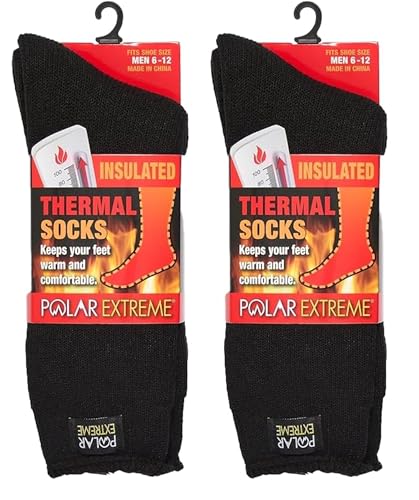
Polar Extreme Thermal Hiking Socks are thick, cushioned socks made from a listed blend of 95% acrylic, 4% elastane, and 1% other fiber. Their synthetic insulation and stretch are intended to retain loft while accommodating movement inside winter boots. Reinforcement at the heel and toe targets common wear areas, making this two-pair package relevant for work boots, snow boots, and other substantial footwear. Despite the hiking name, the bulky design appears better suited to cold, low-to-moderate activity than fast-paced winter hiking where heat and perspiration can build quickly.
These socks are included for buyers who have enough boot volume to use dense synthetic cushioning without compressing their feet. They may be especially useful for standing, clearing snow, attending outdoor events, or completing moderate work in cold conditions. The supplied product information contains inconsistent sizing references, with one description mentioning a 6-to-12 range and another stating men’s sizes 10 to 14. Buyers should therefore verify the currently selected variation and size information before ordering. No independent temperature rating is supplied, so claims about subzero or polar performance should be treated as manufacturer positioning rather than a guarantee.
Pros:
- High-acrylic blend provides substantial synthetic insulation
- Elastane adds stretch and helps maintain fit
- Reinforced heel and toe address high-wear zones
- Full cushioning can improve comfort in rigid winter boots
- Two pairs allow one pair to dry while the other is worn
Cons:
- Conflicting size information requires careful verification
- Bulk may restrict circulation in closely fitted footwear
- Heavy insulation can become too warm during sustained high-output activity
Polar Extreme socks prioritize cushioning and loft rather than a trim, technical fit. They are worth considering for spacious boots and slower winter activities, provided the selected size is confirmed first. People using fitted hiking or ski boots should compare sock thickness with available footwear volume before choosing them.
Best for: Low-to-moderate activity in roomy snow, work, or winter boots.
Alvada Warm Thermal Wool Socks

Alvada Warm Thermal Wool Socks use a wool-blend construction with a fully cushioned footbed, reinforced yarn at the heel and toe, arch compression, and ventilation channels. These features make them a more structured option than loose, fuzzy cabin socks. The wool blend is intended to regulate temperature and move moisture, while airflow channels can help reduce the damp feeling that develops during walking or indoor-to-outdoor transitions. Based on that construction, this model appears suited to hiking, winter commuting, work boots, and other situations where the wearer alternates between movement and periods of lower activity.
The defining feature is the combination of cushioning and midfoot support. Arch compression can help hold a sock in place and reduce bunching, but people with sensitive feet, swelling, or circulation concerns may prefer a less compressive design. The black and charcoal styling is understated enough for daily use, though the padding still requires more space than a standard dress sock. As with any non-waterproof sock, moisture control has limits. If water enters the boot, changing into a dry pair remains important. Buyers should also verify the current size chart rather than relying only on a general unisex description.
Pros:
- Wool blend provides a useful balance of warmth and moisture management
- Fully cushioned footbed supports extended wear in boots
- Arch compression may reduce slipping and bunching
- Reinforced heel and toe improve the construction of high-wear areas
- Ventilation channels make the design more suitable for activity than dense fleece socks
Cons:
- Arch compression may feel restrictive to some wearers
- Cushioning can be too thick for narrow or precisely fitted footwear
- No waterproof membrane or barrier is included
This Alvada model is a sensible option for people who want more support and structure than a basic wool sock provides. It fits best into active daily routines where cushioning and moisture control both matter. Those with swelling, neuropathy, or circulation problems should avoid unnecessary compression and consult appropriate medical guidance when needed.
Best for: Supported winter walking, commuting, and active wear in boots with adequate room.
Busy Socks Extra Thick Insulated Thermal Socks

Busy Socks Extra Thick Thermal Socks are heavily brushed crew socks intended to create a deep insulating layer around the foot. The plush synthetic interior makes them substantially different from fitted merino hiking socks. Two size ranges are listed: medium for men’s sizes 6 to 9.5 and women’s sizes 7 to 9.5, and large for men’s sizes 9 to 12 and women’s sizes 10 to 13. Defined ranges can help buyers avoid some of the uncertainty associated with broadly sized thermal socks. Their thickness appears best suited to roomy work, hunting, snow, or casual winter boots.
These are a strong candidate for extended low-activity exposure, including outdoor work with periods of standing, winter camping around a campsite, or use at home. They can also be worn while hiking or skiing if the footwear accommodates them, but thicker is not always warmer in close-fitting technical boots. The fuzzy lining can trap heat effectively, yet it may also hold perspiration during strenuous movement. Despite the word heated appearing in the full marketplace title, this is not an electric sock and does not contain a battery or active heating element. The package includes one pair, which also affects its value relative to multi-pair sets.
Pros:
- Heavily brushed lining provides substantial loft and insulation
- Separate medium and large ranges offer clearer sizing than many broad-fit socks
- Suitable for low-output outdoor use and cold indoor floors
- Unisex sizing covers a useful range of men’s and women’s shoe sizes
- Thick cushioning can soften rigid or roomy boots
Cons:
- One pair per package offers less rotation value
- Very thick construction can restrict circulation in snug footwear
- Plush lining may retain perspiration during high-output activity
Busy Socks are among the more insulation-focused options in this guide. Their value depends on footwear volume and activity level, not thickness alone. They make the most sense for cold, relatively stationary use in boots that leave room to wiggle the toes, rather than tightly fitted ski or hiking footwear.
Best for: Outdoor work, cold campsites, and prolonged low-activity use in roomy boots.
SIMIYA Merino Wool Socks for Men
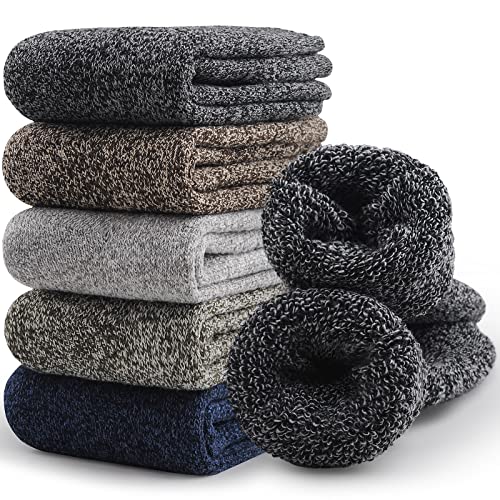
SIMIYA Merino Wool Socks are thick crew socks made with a blend of merino wool, nylon, and spandex. Wool supports temperature regulation and moisture absorption, nylon adds strength, and spandex helps the sock stretch around the foot and leg. The five-pair set comes in varied colors and is listed for men’s shoe sizes 7 to 13. These socks appear appropriate for everyday boots, moderate hiking, work, and indoor use. They provide a more activity-friendly fiber mix than cotton-rich casual socks, though the thick construction may still be too bulky for close-fitting footwear.
The main advantage is the number of wool-blend pairs at an accessible package price. Having several pairs is useful in cold weather because a dry sock is safer and more comfortable than repeatedly wearing one damp pair. The broad size range is the principal compromise. A person at size 7 may experience more fabric than someone near size 13, while the larger wearer may stretch the cushioning more thinly. The supplied specifications do not state the percentage of merino wool, so shoppers should not assume the behavior of a high-merino technical hiking sock. This set is better viewed as a versatile winter rotation than specialized expedition footwear.
Pros:
- Five pairs provide a practical supply for regular rotation
- Merino wool, nylon, and spandex combine warmth, structure, and stretch
- More suitable for changing activity levels than a cotton-heavy blend
- Crew height works with casual, work, and many hiking boots
- Varied colors make it easy to distinguish pairs in a household
Cons:
- Merino wool percentage is not included in the supplied product details
- Single size range from 7 to 13 may not fit both ends equally well
- Thickness can create pressure in low-volume boots
The SIMIYA set offers practical everyday value for shoppers who want multiple wool-blend socks rather than one specialized pair. It is a reasonable choice for work, walking, and general winter wear. For long technical hikes, prioritize precise sizing and detailed fiber percentages over pair count alone.
Best for: Men seeking an affordable five-pair wool-blend rotation for everyday winter boots.
Velice Winter Thermal Socks for Women

Velice Winter Thermal Socks are women’s crew socks made from 82% acrylic, 15% polyester, and 3% spandex, with a plush fleece-like lining and full cushioning. The package includes five pairs and is listed for women’s shoe sizes 5 to 10. Their synthetic construction is designed to create softness and insulating loft without wool, making them relevant for shoppers with wool sensitivity or a preference for fuzzy interiors. These socks appear best suited to casual boots, commuting, home use, and moderate outdoor activity where substantial cushioning is welcome.
Among the women’s options here, the Velice set provides the largest rotation and a clearly stated fiber composition. The thick lining can help fill spacious rain, duck, or snow boots, but it may overwhelm fitted hiking or ski boots. Acrylic and polyester do not absorb moisture like cotton, although the dense interior can still trap sweat during strenuous activity. They are sometimes marketed using the term heated, but the supplied description indicates ordinary insulated socks rather than an electric heating system. Women who hike quickly or run warm may be better served by a thinner wool-synthetic performance sock.
Pros:
- Five-pair package provides convenient winter rotation
- Plush synthetic lining offers a soft, wool-free interior
- Full cushioning can improve comfort in stiff or roomy boots
- Spandex adds stretch for a closer fit
- Clearly listed fiber percentages make the construction easier to evaluate
Cons:
- Dense lining can retain perspiration during strenuous activity
- Thick profile may not fit safely inside narrow boots
- Broad size range may be less precise at the smallest and largest ends
Velice Thermal Socks are a practical women’s choice for casual winter warmth, especially when several pairs are needed for daily rotation. They favor softness and insulation over technical breathability. Pair them with spacious footwear and switch to a thinner performance sock when sustained hiking or skiing creates more heat and moisture.
Best for: Women’s casual winter wear, commuting, and roomy everyday boots.
How to Choose Socks for Extreme Cold
Match the Sock to Your Activity Level
People who stand still lose heat differently from people who hike, ski, or perform physical work. Low activity produces less body heat, so a thick brushed sock can be useful when standing at an outdoor event, operating equipment, or waiting in cold conditions. The extra loft creates insulating air space, assuming the boot does not compress it.
During strenuous movement, moisture management becomes more important. A very thick sock can cause overheating and perspiration. Once activity slows, that moisture can contribute to rapid cooling. For hiking and other sustained movement, a wool-synthetic blend with moderate cushioning is often a better starting point than the thickest available fleece-lined sock.
| Activity | Useful Sock Characteristics | Main Concern |
|---|---|---|
| Standing or low-output outdoor work | High loft, full cushioning, soft brushed lining | Boot pressure and restricted circulation |
| Winter hiking | Wool-synthetic blend, moisture control, secure fit | Overheating and dampness |
| Skiing or snowboarding | Precise fit, moderate cushioning, low bulk around the calf | Thick socks can interfere with boot fit |
| Commuting and errands | Moderate warmth, easy care, everyday comfort | Becoming too warm indoors |
| Home use | Soft lining and relaxed comfort | Lack of traction on smooth floors |
Understand the Material Trade-Offs
Merino wool is widely used in cold-weather socks because it insulates, manages moisture, and remains more comfortable than cotton when slightly damp. It is not waterproof, and a wool blend can vary greatly depending on how much wool it contains. Nylon and polyester are often added for strength, drying performance, and shape retention.
Acrylic is common in thick thermal socks. It can create considerable loft, feels soft, and offers a wool-free option. Brushed acrylic interiors are particularly useful for lower-output wear. Their bulk can be a disadvantage in fitted boots, and dense fibers may trap perspiration during hard activity.
Polyester and nylon are durable synthetic fibers that absorb relatively little moisture and can improve drying. They are normally blended with other fibers rather than relied upon alone for thick insulation.
Cotton can feel comfortable in dry, casual conditions, but it absorbs and retains water. For prolonged outdoor use, especially where sweat, rain, or snow may reach the foot, cotton-rich socks are generally less suitable than wool-synthetic or fully synthetic options.
Check Boot Volume Before Buying Thick Socks
A sock keeps the foot warm partly by trapping air, but that insulating space disappears when footwear is too tight. Pressure can also limit circulation and create cold toes even when the sock itself is highly insulated.
Try the intended sock with the actual boot. You should be able to move your toes, and the foot should not feel pinched across the forefoot or instep. Pay attention to the heel as well. A boot that is too large can cause sliding and blisters, while one that is too small compresses both the sock and foot.
Technical ski boots are a notable example. They are designed around a precise fit and usually work better with a well-fitted, relatively low-bulk ski sock than with a thick fuzzy pair. Snow and work boots often offer more room for plush thermal constructions.
Prioritize a Secure Fit
Excess fabric can wrinkle under the foot and create pressure points. A sock that is too small may stretch thin, reducing cushioning and placing pressure around the toes or calf. Look for sizing based on shoe size rather than vague labels whenever possible.
Arch support and compression zones can help keep a sock in place during movement. They should feel supportive rather than restrictive. People with diabetes, neuropathy, swelling, vascular conditions, or other circulation concerns should seek medical guidance about suitable footwear and socks. Tight cuffs and strong compression are not appropriate for everyone.
Consider Cushioning Placement
Full cushioning provides insulation and softness throughout the foot, but it also takes up the most boot volume. Targeted cushioning places padding under the heel, ball, or shin while reducing material elsewhere. This can provide a better balance for fitted hiking and snow-sport boots.
More cushioning does not automatically mean fewer blisters. Sock fit, boot fit, moisture, and friction all matter. A securely fitted sock that does not bunch is often more comfortable than an oversized plush sock.
Do Not Rely on a Sock to Provide Weather Protection
Most winter socks are not waterproof or windproof. Even when a manufacturer describes fibers as controlling moisture, that generally refers to perspiration management rather than keeping out external water. The boot’s upper, seams, tongue, and sole are responsible for most protection from snow, slush, wind, and standing water.
If the boot becomes wet inside, replace the sock promptly and dry both items. Carrying a spare pair in a sealed bag can be more useful than wearing two thick pairs at once.
Should You Layer Two Pairs of Socks?
Two pairs can work in some situations, but only when the boot has enough volume. A thin moisture-managing liner under a moderately thick outer sock may reduce friction and move perspiration away from the skin. The system should not create wrinkles or pressure.
Wearing two thick socks together is usually less effective. The layers can compress the foot, restrict toe movement, and make the boot fit too tightly. If a single appropriate sock does not provide enough warmth in a properly fitted boot, the footwear may need more insulation or better weather protection.
Care and Maintenance
Care directions vary, so follow the label supplied with the socks. As a general approach, cold washing is gentler on wool blends, elastic fibers, and brushed linings. Turning plush socks inside out may help clean the surface next to the skin, although the manufacturer’s directions take priority.
- Use cold or cool water unless the care label states otherwise.
- Avoid ironing thermal socks.
- Air dry when practical, or use low heat if machine drying is permitted.
- Do not use high heat on wool or elastic blends, as it can cause shrinkage or damage stretch fibers.
- Dry socks completely before storing or wearing them.
- Rotate pairs so damp socks have enough time to dry.
- Replace socks with thin spots, hardened fibers, stretched cuffs, or damaged seams.
Common Winter Sock Mistakes
Choosing the Thickest Sock Without Checking Fit
Thickness is only helpful if the boot can accommodate it. A compressed foot may become colder and more uncomfortable than one wearing a moderately cushioned sock with adequate space.
Wearing Cotton for Wet or Strenuous Activities
Cotton can work for dry indoor use, but it absorbs moisture and dries slowly. For winter hiking, outdoor work, and snow sports, wool-synthetic or fully synthetic socks are generally more practical.
Ignoring Perspiration
Feet can sweat even in very cold weather. Dressing too warmly during hard activity creates dampness that becomes a problem during rest breaks. Adjust insulation to the pace and carry dry socks when exposure will be prolonged.
Assuming “Thermal” Means Electrically Heated
Most thermal socks use fibers and brushed linings to retain body heat. They do not generate heat. A true heated sock requires heating elements, a power source, controls, and specific care instructions. None of the eight products reviewed here is described by the supplied specifications as a battery-powered sock.
Expecting Socks to Replace Insulated Boots
Socks are one part of a cold-weather footwear system. In severe conditions, insulated, properly fitted, weather-appropriate boots are equally important. A warm sock inside a wet or uninsulated boot has limited ability to protect the foot.
Frequently Asked Questions
Are wool socks always warmer than synthetic thermal socks?
No. Warmth depends on fiber blend, fabric density, loft, fit, moisture, and activity. A thick brushed acrylic sock may trap more air than a lightweight wool sock, making it useful during low activity. Wool blends often have an advantage when moisture management and temperature regulation are important.
How thick should socks be for extreme cold?
They should be thick enough to provide insulation and cushioning without making the boot tight. There is no single suitable thickness for every person or activity. Technical ski boots may work best with lower-bulk socks, while roomy snow or work boots may accommodate heavily brushed thermal pairs.
Can I wear winter hiking socks for skiing?
You can if they fit smoothly inside the ski boots, but hiking socks may have more cushioning than necessary. Ski boots typically benefit from a precise sock fit with limited bulk. Avoid folds and excessive material around the calf, shin, and toes.
Why are my feet cold even with thick socks?
Common causes include tight footwear, damp socks, insufficient boot insulation, external water, low activity, and circulation issues. Check whether the toes can move freely and whether the sock is dry. Persistent or unusual coldness, pain, numbness, or color changes warrant medical attention.
Are fleece-lined socks good for hiking?
They may work for slow, short hikes in roomy boots, but dense fleece-like linings can become hot and damp during sustained activity. A wool-synthetic hiking sock with secure sizing and moderate cushioning is usually more versatile for active use.
How many pairs should I bring for a winter trip?
Bring enough to start each day with a dry pair, plus at least one spare for unexpected moisture. The exact number depends on trip length, access to laundry, activity, and drying conditions. Socks can take longer to dry in cold, humid environments.
Should winter socks feel tight around the calf?
They should stay in place without causing pain, deep marks, numbness, or swelling. Compression can help prevent slipping, but it should not feel restrictive. Anyone with circulation concerns should discuss appropriate sock pressure with a qualified medical professional.
Do these socks have reliable temperature ratings?
No independently verified temperature ratings were provided for the products in this guide. Manufacturer use of terms such as extreme cold does not guarantee comfort at a particular temperature. Weather, wind, boot insulation, circulation, activity, and exposure time all influence warmth.
Final Recommendations
Among these eight options, the Alvada Merino Wool Hiking Socks provide a balanced starting point for active winter use, while the Busy Socks Extra Thick Thermal Socks prioritize plush insulation for low-output activities and roomy boots. HOT FEET Thermal Socks offer a soft, wool-free alternative, and the Velice Women’s Thermal Socks provide similar casual warmth in a five-pair women’s package.
For daily rotation, the EBMORE and SIMIYA five-pair sets offer value, but their materials suit different conditions. Choose SIMIYA’s wool-synthetic blend when moisture management matters more, and reserve EBMORE’s wool-cotton blend for comparatively dry, casual use. Whatever sock you select, protect toe room, start with dry footwear, and match insulation to your activity instead of choosing by thickness alone.