Cold feet are not always solved by buying the thickest sock available. A sock that is too bulky can crowd a boot, restrict circulation, and make a long walk less comfortable. For most men, the better choice depends on the footwear, activity level, cushioning needs, and whether the day involves steady movement or long periods standing in cold conditions.
The best merino wool socks for men combine wool with durable synthetic fibers, then use cushioning, ventilation, and a secure fit to suit a particular purpose. Merino helps manage moisture and temperature, but the wool percentage alone does not determine whether a sock is right for winter hiking, job-site boots, running shoes, or everyday wear.
Quick Answer
For a dependable all-purpose hiking sock, the Darn Tough Hiker Micro Crew Cushion offers a balanced merino blend, midweight cushioning, and a lifetime guarantee. Men who need substantial cushioning for demanding boot use may prefer the DANISH ENDURANCE Merino Wool Hiking Socks. For lower-cut athletic shoes, the Busy Socks Ankle Hiking Socks provide a six-pair, no-show option with ventilation and targeted support.
Budget-focused shoppers should compare the five-pair ANTSANG Hiking Socks, MOGGEI Hiking Socks, and SIMIYA Winter Socks, while the RUIXUE Hiking Socks are a moderate-thickness choice with a wider published size range. Before ordering, check the listed shoe-size range and consider how much room your boots have for a cushioned wool sock.
Comparison Table
| Product | Best For | Material or Cushioning | Height | Notable Trade-Off |
|---|---|---|---|---|
| Darn Tough Hiker Micro Crew Cushion | Frequent hiking and long-term value | 63% merino blend, midweight cushion | Micro crew | Higher cost per pair |
| DANISH ENDURANCE Hiking Socks | Boot hiking and outdoor work | 38% merino blend, heavy cushioning | Crew | Thicker construction may crowd close-fitting boots |
| Busy Socks Ankle Hiking Socks | Running, gym use, and low-cut shoes | 40% wool blend, half cushioning | No-show ankle | Limited cold-weather calf coverage |
| ANTSANG Hiking Socks | Active use and five-pair value | 70% wool blend, targeted cushioning | Crew | Only two published size ranges |
| MOGGEI Hiking Socks | Snug work or hiking socks | 70% merino blend, targeted cushioning | Crew | Compression-focused fit may not suit everyone |
| Alvada Hiking Socks | Cold-weather hiking on a budget | Merino and nylon blend, shaped footbed cushion | Crew | Published fiber percentages are not provided |
| Time May Tell Hiking Socks | Thick work-boot cushioning | 80% merino blend, terry cushioning | Crew | Bulkier than a moderate-weight hiking sock |
| RUIXUE Hiking Socks | Moderate thickness and broad sizing | 50% merino blend, terry sole | Boot sock | Less wool content than several alternatives |
| SIMIYA Winter Socks | Inexpensive casual winter rotation | Merino, nylon, and spandex blend | Crew | One stated size range is broad |
How We Chose These Picks
These recommendations were selected from the supplied manufacturer and marketplace information, with an emphasis on distinct uses rather than a single universal winner. We considered wool content where disclosed, cushioning, height, reinforcement, ventilation features, available sizing, pack size, care instructions, and the type of footwear each sock appears intended to complement.
A heavy hiking sock can make sense inside roomy boots but may be uncomfortable in fitted casual shoes. Likewise, a thin ankle sock may work well for a winter run but offer little insulation around the lower leg during a slow, cold work shift. The list includes options across these different needs, along with trade-offs worth considering before purchase.
Our Top Picks for Men’s Merino Wool Socks
These socks are not arranged as a simple ranking. Each fills a different role, from premium hiking use to low-cut athletic wear and economical multi-pair packs. Compare the weight, height, stated fiber content, and fit features against the boots or shoes you wear most often. A sock that matches your footwear and daily activity is usually more useful than one chosen only for its warmth.
Darn Tough Men’s Hiker Micro Crew Cushion Socks

The Darn Tough Hiker Micro Crew Cushion is a midweight hiking sock made with 63% merino wool, 35% nylon, and 2% Lycra spandex. Its micro-crew height rises just above a standard hiking boot, offering useful coverage without the full length of a traditional crew sock. The construction includes mid-level cushioning underfoot and a seamless toe design intended to reduce the noticeable ridge that can cause rubbing on long walks. Merino provides moisture-management and temperature-regulating properties, while nylon adds durability in a sock category that receives frequent friction at the heel and forefoot.
This is the most established premium option in this group for men who hike often, wear boots regularly, or prefer to buy fewer pairs with a strong durability policy. Darn Tough states that the socks are made in Vermont and backs them with a lifetime guarantee. The trade-off is the cost per pair, which is substantially higher than multi-pair packs. Its medium cushion also is not the thickest here, so men seeking a very padded work-boot sock may prefer a heavier alternative.
Pros:
- 63% merino wool blend balances warmth, moisture management, and durability.
- Midweight cushioning is practical for hiking boots and everyday outdoor use.
- Micro-crew height works with many standard hiking boots.
- Seamless toe construction may help reduce friction.
- Manufacturer lifetime guarantee adds long-term value.
Cons:
- Higher upfront price than multi-pair options.
- Mid-level cushioning may not suit those wanting a thick thermal sock.
Men who place a high value on construction, a well-known merino blend, and long-term replacement support will likely find this a sensible premium choice. It is especially suitable for regular hiking and boot wear, provided the midweight profile matches the available room in the boot.
Best for: Frequent hikers, travelers, and men seeking a durable midweight hiking sock with a lifetime guarantee.
DANISH ENDURANCE Merino Wool Hiking Socks

DANISH ENDURANCE Merino Wool Hiking Socks are built around thick, heel-to-toe cushioning for use in hiking boots, trekking footwear, and work boots. The listed blend contains 38% merino wool, 30% polyamide, 30% acrylic, and 2% elastane. That relatively durable synthetic content is important in a heavily cushioned sock because it helps maintain structure through repeated wear. The crew-style design is intended for year-round outdoor use, with merino helping move moisture away from the skin in addition to providing warmth in cold weather.
These are a practical pick for men who need more protection underfoot than a standard casual wool sock provides. The all-over cushioning may be useful on uneven trails or during long shifts spent standing and walking. They are made in Portugal, and the manufacturer recommends washing at no more than 40°C, or 105°F, with wool detergent and avoiding tumble drying. Their bulk is the important consideration. Men with narrow boots or a close, performance-oriented boot fit should make sure there is enough interior volume before choosing a thick sock.
Pros:
- Heavy heel-to-toe cushioning for high-impact boot use.
- Merino blend supports moisture management across changing conditions.
- Polyamide and acrylic contribute durability and shape retention.
- Made in Portugal.
- Manufacturer offers a one-year anti-hole guarantee.
Cons:
- 38% merino content is lower than several other socks in this guide.
- Heavy cushioning can feel too bulky in close-fitting footwear.
For roomy hiking or work boots, this sock emphasizes cushioning and protection over a slim profile. It is most compelling for users whose feet become sore from long days on hard ground, rather than for runners or people who need a lightweight sock inside a low-volume shoe.
Best for: Hiking, trekking, and outdoor work in boots with enough space for a heavily cushioned crew sock.
Busy Socks Ankle Merino Wool Hiking Socks
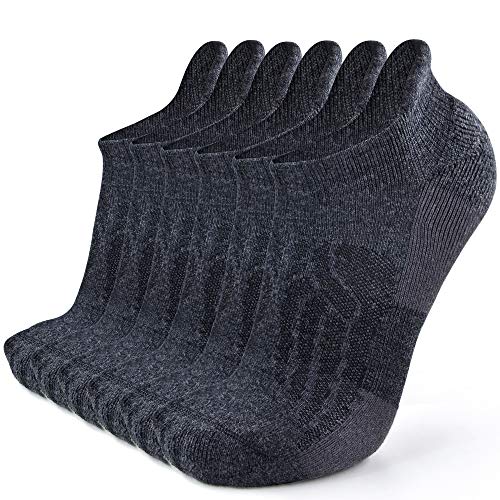
Busy Socks Ankle Hiking Socks are a low-cut, tab-style alternative for men who wear running shoes, trail shoes, or casual sneakers rather than tall boots. This six-pair pack uses a 40% wool blend and includes mesh ventilation lanes, sole cushioning, a reinforced heel, smooth toe construction, elastic cuff, and arch-support styling. The heel tab can help protect the back of the ankle from shoe-collar friction while making the sock easier to pull on. Its lower profile is better aligned with active movement and warm indoor settings than with deep snow or exposed winter work.
The appeal here is versatility across athletic and everyday use, combined with a larger pack for a regular laundry rotation. It may suit walking, gym sessions, jogging, light hiking, cycling, and errands when a crew sock would feel excessive. However, the no-show height means less coverage and insulation around the ankle, particularly in cold wind or when wearing taller boots. The manufacturer also notes that wool-blend socks can pill over time, a normal result of fiber friction that careful laundering can help minimize.
Pros:
- Low-cut profile fits running shoes and other low-top footwear.
- Six-pair pack is useful for frequent athletic wear.
- Mesh zones support airflow during active use.
- Heel tab and smooth toe target common friction areas.
- Reinforced heel and sole cushioning add practical durability and comfort.
Cons:
- Low height offers limited protection from cold around the ankle.
- 40% wool blend has less wool than many crew hiking socks.
This is a sensible choice when the priority is an athletic, lower-cut wool-blend sock rather than a winter boot sock. Men who alternate between exercise, walking, and casual sneakers may get more use from this pack than from thick crew socks that are too warm or bulky indoors.
Best for: Men who want cushioned, low-cut wool-blend socks for running, walking, gym use, and casual shoes.
ANTSANG Merino Wool Hiking Socks

ANTSANG Hiking Socks come in a five-pair pack and use a listed blend of 70% wool, 23% polyester, 5% spandex, and 2% nylon. Their design combines targeted plantar cushioning with mesh ventilation areas, an arch band, heel shaping, and a seamless toe. The brand describes its ventilation layout as a dynamic air-circulation system, but the practical takeaway is a sock intended to balance warmth with airflow during movement. The cushioning is concentrated where feet absorb repeated impact, making the pair more appropriate for hiking, walking, climbing, and similar active use than for dress shoes.
This pack offers a high stated wool content at a moderate price, making it worth considering for men building a practical rotation of outdoor socks. The arch and calf-support elements may appeal to those who prefer a more held-in feel, though fit preferences vary and some users may find support bands restrictive. Available sizing is limited to medium and large, with the manufacturer listing large for men’s US sizes 8.5 to 12. Men near a size boundary, with unusually wide feet, or who prefer a relaxed fit should check the size chart carefully.
Pros:
- Listed 70% wool blend supports winter warmth and moisture control.
- Five-pair pack provides useful value for regular wear.
- Targeted cushioning helps protect high-impact areas.
- Ventilation zones are designed to improve airflow during activity.
- Seamless toe and shaped heel address rubbing and bunching concerns.
Cons:
- Only medium and large sizes are listed.
- Support-focused construction may feel snug for some wearers.
ANTSANG is a strong value-oriented choice for men who want several cushioned wool-blend socks for active use. It is best approached as a hiking and walking sock, not an ultralight running option. Leave adequate room in boots to accommodate the cushioning and support structure.
Best for: Active hikers and walkers who want a five-pair wool-blend pack with targeted cushioning and a supportive fit.
MOGGEI Merino Wool Hiking Socks

MOGGEI Merino Wool Hiking Socks use a 70% merino wool blend with polyester, spandex, and nylon, supplied in a five-pair crew-sock pack. The design includes mesh ventilation, targeted cushioning, a reinforced heel, and a seamless toe. A broad compression-zone layout is intended to keep the sock securely in place around the foot and lower leg, while the cushioning helps soften the repeated impact of walking, hiking, and standing. With its higher merino content and winter-oriented crew construction, this is more naturally suited to boots than thin sneakers.
Men seeking a snug, stable sock for work, trail walking, or cold-weather everyday use may find this pack appealing. The stated size options are medium for men’s US 5 to 8 and large for men’s US 8 to 11, so shoppers above that range should look elsewhere. It is also important not to treat compression styling as medical support or a treatment for foot conditions. The practical benefit is simply a closer fit that may reduce slipping and bunching when the sizing is correct.
Pros:
- 70% merino wool blend for substantial wool content.
- Five-pair pack supports an everyday winter rotation.
- Targeted cushioning and reinforced heel suit boot use.
- Ventilation features help manage moisture during movement.
- Seamless toe is designed to reduce toe-area friction.
Cons:
- Published men’s sizing tops out at US size 11.
- Close, compression-style fit may not suit men who prefer looser socks.
For men within the listed size range, MOGGEI provides an affordable way to add several wool-rich, cushioned crew socks to a cold-weather wardrobe. It makes the most sense for boots and active daily use where a secure fit is helpful, rather than as a casual dress sock.
Best for: Men who prefer a secure-fitting, wool-rich crew sock for hiking, walking, work boots, and winter errands.
Alvada Merino Wool Hiking Socks

Alvada Merino Wool Hiking Socks are thermal crew socks sold as a three-pair pack for hiking and winter boot wear. The manufacturer describes a merino wool and nylon blend designed to provide warmth while avoiding the scratchy feel some people associate with traditional wool. A shaped, cushioned footbed is the central feature, intended to make longer walks and uneven terrain easier on the foot. The crew height works well with hiking boots, providing a barrier between the boot collar and lower leg while helping retain warmth in cold conditions.
This is a straightforward option for men who need basic cushioned hiking socks at an accessible price. The product information emphasizes machine washing on cold, which is convenient for frequent use. However, the published listing does not provide exact fiber percentages, so buyers comparing wool content closely may prefer a sock with a fully disclosed composition. It also does not offer the more specialized mesh zones, defined support bands, or lifetime policy found on certain alternatives. Its strength is a simple, boot-ready construction rather than technical detail.
Pros:
- Cushioned footbed is intended for hiking and long walks.
- Crew height pairs naturally with hiking and winter boots.
- Merino and nylon blend aims to balance comfort and durability.
- Three-pair pack is practical for occasional outdoor use.
- Cold-machine-wash guidance simplifies routine care.
Cons:
- Exact fiber percentages are not listed in the supplied product information.
- Less specialized ventilation and fit support than some competitors.
Alvada is best viewed as a basic cold-weather hiking sock for someone who wants cushioning and crew coverage without paying premium per-pair pricing. It should work most naturally with boots that have enough room for a thicker footbed, especially for occasional hikes and winter walks.
Best for: Occasional hikers and winter walkers who want a simple three-pair, cushioned crew-sock pack for boots.
Time May Tell Men’s Merino Wool Hiking Cushion Socks

Time May Tell Men’s Merino Wool Hiking Cushion Socks use an 80% merino wool blend and thick terry-loop cushioning. This three-pair crew pack is designed for winter boots, hiking footwear, and work boots, where extra padding and moisture absorption can be more valuable than a minimal fit. The socks have a seamless interior construction and are described as sitting below the calf. Their thick terry profile is intended to provide warmth in cold conditions while the merino fibers help manage moisture during hiking or work activity.
The relatively high stated merino content makes this a noteworthy option for men whose priority is a warm, padded boot sock. It can be suitable for outdoor work as well as hiking, particularly when footwear has sufficient volume. The same construction is less suited to narrow boots, slim casual shoes, or anyone who overheats easily during high-output exercise. The manufacturer describes the socks as machine washable, though it is still wise to follow the care label and avoid excessive heat, which can be hard on wool fibers and elastic components.
Pros:
- Listed 80% merino wool blend is among the highest in this guide.
- Thick terry-loop cushioning supports winter boot comfort.
- Three-pair pack provides rotation for hiking or work use.
- Seamless construction is intended to improve interior comfort.
- Crew coverage works well with boots and outdoor clothing.
Cons:
- Thick profile can take up significant room inside footwear.
- May be overly warm for indoor wear or intense exercise.
Men who run cold, spend time outside at a slower pace, or wear roomy work boots may appreciate the focus on wool content and dense cushioning. This is not a thin all-season athletic sock, but it can be a useful dedicated option for cold-weather boot days.
Best for: Men seeking a thick, wool-rich, terry-cushioned sock for roomy winter boots and outdoor work.
RUIXUE Merino Wool Hiking Socks

RUIXUE Merino Wool Hiking Socks use a 50% merino wool, 30% nylon, 17% acrylic, and 3% Lycra blend, with a terry-cushioned sole and breathable mesh sections. They are designed as moderate-thickness boot socks rather than especially thick thermal socks, which makes them more adaptable across hiking boots, sneakers, and some casual shoes. The listing also specifies a seamless toe, reinforced high-wear areas, and four size ranges, including a men’s large/wide option listed for US sizes 12 to 15. The product is identified as OEKO-TEX and GRS certified by the manufacturer.
This is a useful middle-ground choice for men who need more sizing flexibility than most inexpensive wool-sock packs provide. The moderate profile may be easier to fit into different footwear than a dense terry winter sock, while still offering cushioning for daily walks and work shifts. Its 50% merino content is lower than some products here, but nylon and acrylic are included to support abrasion resistance and shape retention. Buyers looking specifically for maximum wool content or maximum cold-weather loft should compare it with thicker, higher-merino alternatives.
Pros:
- Moderate thickness can work across several types of footwear.
- Four listed size ranges include an option for men’s US sizes 12 to 15.
- Terry sole provides underfoot cushioning.
- Mesh panels and merino blend support moisture management.
- Seamless toe and stretch fibers are designed for a secure fit.
Cons:
- 50% merino content is lower than the wool-richest options.
- Moderate cushioning may not satisfy those wanting a very thick boot sock.
RUIXUE is particularly worth considering for men who struggle to find wool-blend socks in a broader size range or who want one sock weight for work, walking, and travel. It offers a measured balance of cushioning and versatility instead of specializing in maximum warmth.
Best for: Men wanting a moderate-weight merino blend with broader listed sizing, including larger and wider feet.
SIMIYA Merino Wool Winter Socks for Men
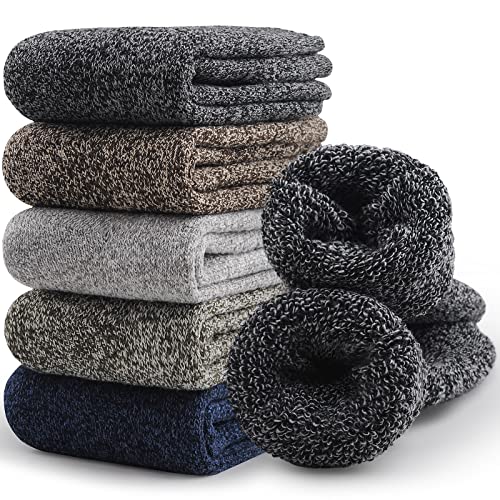
SIMIYA Merino Wool Winter Socks are thick crew socks supplied in a five-pair pack. The manufacturer lists a blend of merino wool, nylon, and spandex, with an emphasis on softness, stretch, warmth, and breathability. They are designed broadly for winter use, including boots, casual wear, indoor use, and outdoor activity. The thicker knit can help add insulation inside roomy footwear, while the nylon and spandex content should help the sock stretch and recover its shape better than pure wool. Several colors are included, which can be useful for a simple weekly rotation.
At the lower end of the price range, this pack is most suitable for men who want basic winter socks for commuting, errands, lounging, or occasional outdoor use. It is not the most technical option for long-distance hiking because the supplied specifications do not detail a reinforced heel, seamless toe, or specific cushioning zones. The stated one-size range of US men’s 7 to 13 is also unusually broad, so fit may vary considerably across that span. Men near either end of the range should review current sizing information before ordering.
Pros:
- Five-pair pack offers low-cost winter rotation.
- Thicker knit is suited to cold-weather casual use.
- Merino, nylon, and spandex blend combines warmth with stretch.
- Crew height works with many boots and everyday shoes.
- Multiple colors add variety for daily wear.
Cons:
- Exact fiber percentages are not disclosed in the supplied information.
- Broad stated size range may not deliver the same fit for every foot.
SIMIYA makes sense as an economical winter-sock pack when the goal is simple warmth and a variety of pairs, rather than technical trail performance. It is a practical backup for cold mornings and casual boots, but dedicated hikers may prefer a more precisely fitted, reinforced sock.
Best for: Budget-minded men who need a basic five-pair supply of thick crew socks for casual winter use.
How to Choose Merino Wool Socks for Men
Match Sock Thickness to Your Footwear
Thick socks are not automatically warmer in practice if they make boots too tight. A crowded boot can compress insulation, reduce toe movement, and make feet feel colder or sore. Use heavily cushioned styles, such as the DANISH ENDURANCE or Time May Tell socks, with boots that have enough internal space. Moderate-weight styles are more flexible for everyday shoes and travel, while no-show socks are primarily for sneakers and active footwear.
Consider Wool Content Alongside the Blend
Merino wool can help manage moisture and odor while providing insulation even when conditions change. However, nylon, polyester, acrylic, and elastane have practical roles. They can improve durability, stretch, drying time, and shape retention. A 70% or 80% merino blend may appeal to shoppers prioritizing wool content, but a lower-merino blend can still be a sensible choice if it fits better, lasts longer in high-friction areas, or suits a specific activity.
Choose Cushioning for Your Activity
Heavy cushioning is most useful for hiking, outdoor work, and long periods on hard surfaces. It can help reduce direct pressure from boot soles and add comfort around the heel and forefoot. Moderate cushioning is often more versatile for travel and all-day casual wear. For running or gym workouts, excess padding can make a shoe feel cramped and may retain more heat than desired.
Check Height and Lower-Leg Coverage
Micro-crew and crew socks are the usual choices for hiking boots because they extend above the boot collar. This helps prevent direct rubbing between the boot and skin. Lower-cut ankle socks work better with trail runners and sneakers, but they expose more of the ankle to cold air, debris, and shoe-collar friction. Select height based on the footwear, not just personal preference.
Do Not Treat Fit Features as Medical Claims
Arch bands and compression-style zones can make a sock feel more secure and may reduce slipping inside footwear. They are not a substitute for medical treatment, custom orthotics, or professional advice for persistent foot pain, circulation concerns, or plantar fasciitis. If you have a health condition affecting your feet, consult an appropriate clinician before relying on a sock’s support features.
Care for Wool Blends Gently
Always follow the label, but a cold or cool wash cycle and low-heat or air drying are commonly gentler approaches for wool blends. High heat can damage elastic fibers and contribute to shrinkage. Turn socks inside out before washing, avoid fabric softener when the care instructions discourage it, and keep a rotation of several pairs so no single pair is worn every day.
Common Mistakes When Buying Winter Socks
- Buying only for wool percentage: A high-wool sock may still be wrong if the thickness, height, or fit does not suit your boots.
- Ignoring shoe volume: Thick socks can make otherwise comfortable footwear painfully tight.
- Using low-cut socks with tall boots: This can leave skin exposed to rubbing at the boot collar.
- Expecting one pair to cover every use: Many men benefit from keeping a cushioned boot sock and a lighter athletic sock for different days.
- Overlooking size charts: Socks that are too large can bunch, while undersized socks can restrict movement and wear out faster.
- Drying on high heat: This can shorten the working life of wool and stretch fibers.
Frequently Asked Questions
Are merino wool socks warm enough for winter?
Merino wool socks can provide useful winter warmth, especially in a crew-height, cushioned construction worn with appropriate boots. Warmth also depends on the boot’s insulation, fit, activity level, moisture exposure, and whether the sock is compressed by tight footwear. A thick wool sock in an overly tight boot can be less comfortable and less effective than a moderate sock in a properly fitted boot.
Should men wear thick or thin merino socks for hiking?
Choose thickness based on boot volume, weather, terrain, and personal comfort. Moderate cushioning is often a versatile choice for many hikes. Thick cushioning can make sense for cold conditions, hard terrain, or roomy boots. Thin socks are better suited to warm conditions, low-volume footwear, or high-output activity where excess heat is a concern.
Are merino wool socks good for sweaty feet?
Merino fibers can absorb moisture vapor and help move moisture away from the skin, which can make them more comfortable than many basic cotton socks during activity. They are not a guarantee that feet will stay dry in soaked footwear or extremely demanding conditions. Ventilation, shoe breathability, changing socks when needed, and proper boot fit also matter.
How many pairs of merino socks should you own?
For occasional use, three pairs can be enough to rotate between washes. Men who hike, work outdoors, or wear wool socks most days in winter may find five to seven pairs more practical. A larger rotation also gives socks time to dry completely and can reduce wear on any individual pair.
Can merino wool socks be worn in warm weather?
Yes, lighter or moderate-weight merino blends can work well in mild weather because merino helps manage moisture and temperature. Thick terry socks may still feel too warm for summer or high-intensity exercise. For warm-weather running or casual use, a lower-cut sock with mesh panels is usually more appropriate than a thick winter crew sock.
Final Recommendations
Choose the Darn Tough Hiker Micro Crew Cushion if you want a premium, midweight hiking sock with a strong long-term guarantee. Choose DANISH ENDURANCE or Time May Tell when substantial cushioning and boot-focused warmth are more important than a slim fit. For active sneakers, Busy Socks provides the most suitable low-cut profile, while ANTSANG and MOGGEI offer wool-rich multi-pair packs for hiking and daily outdoor use.
For casual winter rotation on a tighter budget, SIMIYA and Alvada are straightforward choices, though their technical specifications are less detailed. RUIXUE is the practical middle option for men seeking moderate thickness and a broader listed size range. The right pair is the one that fits securely, leaves room in your footwear, and matches the conditions you actually face.