Buying a garage heater gets complicated quickly once you move past the basic question of watts. A heater that works well in a finished hobby garage may be a poor fit for a drafty two-car workshop, and a powerful 240-volt ceiling unit is not automatically the right answer for every homeowner. Installation requirements, airflow, electrical capacity, mounting location, and how you actually use the space matter just as much as raw heat output.
This garage heater buying guide focuses on the practical side of choosing one. Instead of treating every garage the same, it helps sort out which heater style makes sense for light-duty use, regular workshop use, and spaces where preserving floor area is important. The available product data for this topic is limited, so the recommendations section below covers the clearly relevant heater models from that list and explains where each one fits.
Quick Answer
For most people shopping for a garage heater, a ceiling-mounted electric unit is the most logical place to start because it keeps the floor clear and is designed for utility spaces. In the current product set, the Comfort Zone 5000W Ceiling Mounted Garage Heater is the closest match for a typical garage heating need. If your garage is more like a finished workspace, home gym, or insulated hobby area, a wall-mounted heater such as the Dreo Smart Wall Heater WH719S or DREO Smart Wall Heater IP24 may be more appropriate, but both are indoor comfort heaters first and true garage heaters second.
Comparison Table
| Product | Type | Power | Installation | Best Use | Main Trade-Off |
|---|---|---|---|---|---|
| Comfort Zone 5000W Ceiling Mounted Garage Heater | Fan-forced electric garage/shop heater | 5000W, 240V | Ceiling mount, hard-wired | Typical garages, workshops, utility spaces | Needs 240V circuit and permanent installation |
| Dreo Smart Wall Heater WH719S | Wall-mounted PTC heater | 1500W | Wall mount | Insulated small work areas, finished garage zones | Not intended for heavy-duty garage heating |
| DREO Smart Wall Heater IP24 | Wall-mounted PTC heater | 1500W class | Wall mount | Small enclosed spaces, light-duty garage comfort | Lower output than dedicated shop heaters |
How We Chose These Picks
For a garage heater article, the most important filters are simple. First, the product needs to be meaningfully related to heating a garage or workshop. Second, it needs to solve a distinct use case instead of repeating the same answer in a slightly different package. Third, it should have a clear role based on heating style, installation method, and likely room size.
The product list available for this article included several items that are not actual heaters, such as parking aids, posters, and home repair books. Those may be useful in other contexts, but they do not belong in a serious garage heater buying guide. The picks below are the relevant heating options from the provided data, chosen to represent different types of garage-adjacent heating needs rather than a simple best-to-worst ranking.
Our Top Picks
These heaters serve different situations. One is the straightforward choice for a working garage with enough electrical capacity, while the wall-mounted models make more sense for smaller insulated spaces where comfort, controls, and quieter operation matter more than brute heating power. Compare them based on your garage layout, wiring, insulation, and how long you typically need heat at a time.
Comfort Zone 5000W Ceiling Mounted Garage Heater

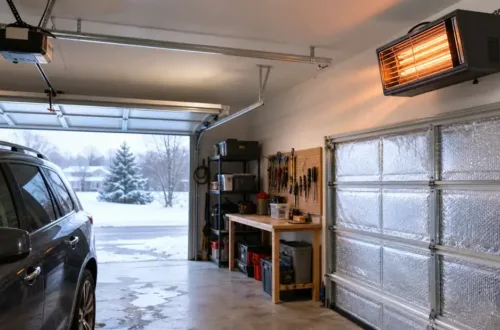
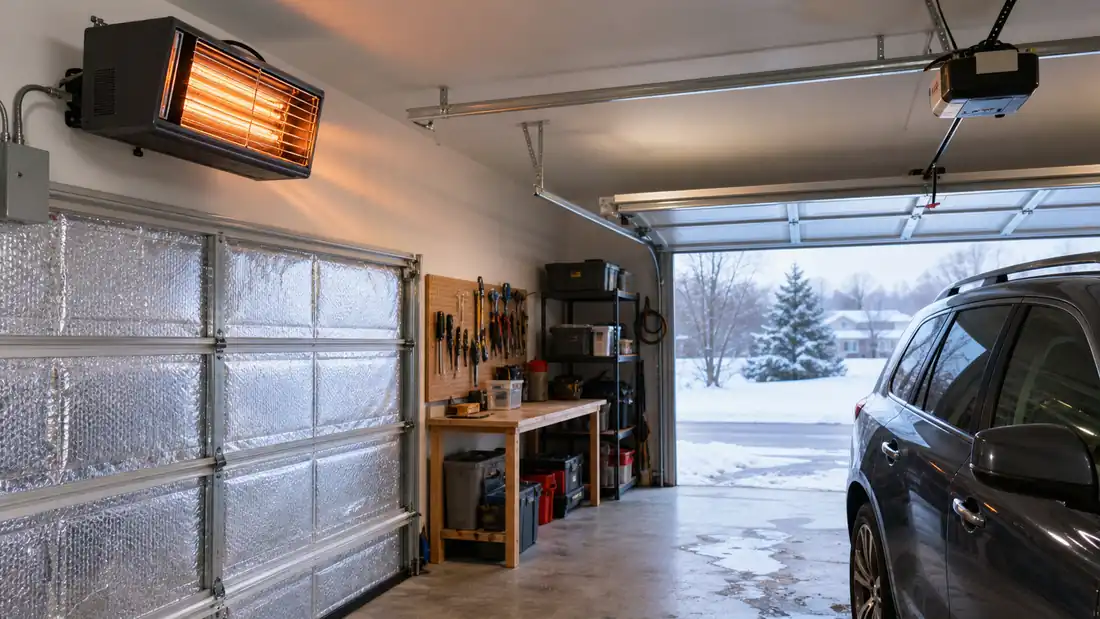
This is the most direct fit for readers specifically shopping for a garage heater. It is a 240-volt, fan-forced electric unit designed to mount overhead, which helps preserve valuable floor space in garages, workshops, and storage areas. The 5000-watt output places it in a more serious category than small plug-in space heaters, and the ceiling-mount format is especially useful when you need heat without creating another obstacle around tools, vehicles, or workbenches. According to the product details, it also includes adjustable louvers and mounting angle control, so you can direct airflow where it is actually needed rather than heating the ceiling and hoping the room eventually catches up.
What makes this model useful in a buying guide is not that it promises to suit everyone, but that it matches the core use case many people have in mind when they search for a garage heater. The steel construction suggests it is built for tougher temperature swings than a standard room heater, and the overheat protection is an important baseline safety feature. The trade-off is installation. Because it is hard-wired and requires 240-volt service, this is a better option for homeowners who already have the proper circuit or are willing to have one installed. It is less suitable for renters, occasional users, or anyone looking for a plug-and-play solution.
Pros:
- 5000W output is more appropriate for garage and shop heating than small room heaters
- Ceiling-mounted design keeps floor and wall space more open
- Adjustable louvers help aim heat toward work areas
- Heavy-gauge steel housing should hold up better in utility spaces
- Includes overheat protection and straightforward manual controls
Cons:
- Requires a 240V hard-wired installation
- Less convenient for users who want portability or temporary heating
- May be more heater than needed for a very small insulated garage bay
For a true garage setup, this is the clearest fit in the group. It favors heating strength and practical placement over smart features, and that is often the right trade in a workshop. If your electrical setup supports it, this is the model most readers should compare first.
Best for: Homeowners with a garage or workshop who want a dedicated, mounted electric heater and have access to a 240-volt circuit.
Dreo Smart Wall Heater WH719S

The Dreo Smart Wall Heater WH719S is a wall-mounted 1500W PTC heater designed more for indoor comfort zones than for raw garage heating power. That distinction matters. If your garage is insulated, used as a hobby room, workout area, or light-duty workspace, a heater like this can be practical because it adds warmth without taking up floor space. The manufacturer lists wide vertical oscillation, app control, voice assistant compatibility, a remote, timer functions, and a reusable filter. Those features point toward convenience and day-to-day comfort rather than the more industrial approach of a ceiling-mounted shop heater.
This model deserves consideration for readers whose garages behave more like finished rooms. If you spend time at a workbench, do crafts, maintain bikes, or use one portion of the garage as a semi-conditioned space, a smart wall heater can make sense. The precise thermostat control and quieter operation may be more appealing than the stronger but simpler output of a dedicated shop heater. Still, the limitation is important. At 1500 watts, it is not the right solution for a cold, drafty, uninsulated two-car garage in the middle of winter. It works best when the space is already somewhat sealed and the heating goal is comfort support, not aggressive cold-weather recovery.
Pros:
- Wall-mounted design keeps the floor clear
- Smart controls, scheduling, and remote operation add convenience
- Precise thermostat settings can help manage comfort and electricity use
- Wide vertical oscillation may distribute heat more evenly in small areas
- Reusable filter and detachable design may simplify maintenance
Cons:
- 1500W output is limited compared with dedicated garage/shop heaters
- Better suited to insulated or semi-finished spaces than drafty garages
- Feature set may be unnecessary if you just need straightforward workshop heat
This is a sensible option when your “garage” is really a multi-use indoor space that needs supplemental warmth. It is less convincing as the main heater for a large or poorly insulated garage, but it can be a good fit for smaller zones where comfort features matter.
Best for: Insulated hobby garages, home gyms, or finished work areas where wall mounting and smart controls matter more than maximum heat output.
DREO Smart Wall Heater IP24

The DREO Smart Wall Heater IP24 fills a similar role to the other wall-mounted Dreo, but with a slightly different feature mix. It uses a PTC heating system, includes remote, app, and Alexa control, and adds an IP24 rating plus overheat protection according to the product details. It also lists low noise operation and a manual 30-degree oscillation function. In practical terms, this is another heater aimed at smaller enclosed areas where you want controllable, on-demand warmth without using floor space. That makes it potentially relevant for compact garage offices, workshop corners, utility rooms attached to garages, or insulated bays that do not need heavy-duty output.
Its place in this guide comes from its lighter-duty, convenience-focused profile. Some readers do not need a high-powered ceiling unit. They need a heater that can take the edge off during short work sessions, keep a small side area comfortable, or operate on a schedule. This model is easier to justify in those circumstances than in a large open garage. The listed primary coverage of about 150 square feet is the clue. You should treat that as a small-area heater first. If your garage has poor insulation, frequent door openings, or a large cubic volume, a dedicated shop heater remains the more realistic path.
Pros:
- Useful for small enclosed spaces where a ceiling garage heater would be excessive
- App, remote, and voice control offer flexible operation
- Low-noise design may suit workspaces used for hobbies or desk tasks
- Wall mounting helps preserve usable floor area
- Includes overheat protection and an IP24 rating in the product details
Cons:
- Not a substitute for a high-output garage heater in larger spaces
- Heating coverage is limited for primary use
- Manual oscillation is less flexible than fully directional workshop airflow
This heater makes the most sense when you need supplemental warmth in a small, controlled section of a garage-related space. It is the more practical choice for comfort-oriented spot heating than for heating an entire cold garage from scratch.
Best for: Small insulated garage rooms, side work areas, or attached utility spaces where quiet operation and smart controls are more important than maximum output.
Garage Heater Buying Guide
Choose the Heater Type Before Comparing Features
The first decision is not brand. It is heater type. In garages, the broad categories that matter most are ceiling-mounted electric shop heaters, wall-mounted electric heaters, and portable heaters. From the available products here, the ceiling-mounted Comfort Zone model represents the dedicated shop-heater route, while the two Dreo models represent wall-mounted comfort heating.
If you need to warm a larger open garage with colder surfaces, higher ceilings, and more air leakage, start with a true garage or shop heater. If the space is insulated and used more like a room, a wall-mounted heater may be enough.
Match Heat Output to the Space
A common mistake is underestimating how hard a garage is to heat. Even a fairly small garage can feel cold if it has an uninsulated slab floor, metal doors, air gaps, or frequent door openings. A 1500W heater may be adequate for a compact insulated work corner, but it is often not enough for a full garage in cold weather.
Heat output needs increase when you have:
- Poor insulation
- High ceilings
- Frequent vehicle traffic
- Detached garage construction
- Cold regional winter temperatures
That is why a 5000W ceiling-mounted unit can make much more sense than a room-style wall heater, even if the smaller heater has more convenience features.
Check Electrical Requirements Early
Electrical compatibility often decides the purchase. A 5000W ceiling heater typically requires a 240-volt circuit and hard-wired installation. That can be entirely reasonable in a workshop, but it is not a casual purchase if your garage is only wired for lights and a few standard outlets.
Before buying, verify:
- Whether the heater uses 120V or 240V power
- Whether hard-wiring is required
- Whether your electrical panel has capacity
- Whether local code or your comfort level calls for a licensed electrician
Wall-mounted 1500W heaters are usually easier to accommodate, but you still need to follow the manufacturer’s installation and clearance instructions.
Mounting Location Affects Real-World Performance
Placement changes how useful a heater feels. Ceiling-mounted heaters are good at freeing up floor area and keeping the unit away from clutter, sawdust piles, and accidental bumps. Wall-mounted heaters also save space, but they are generally better for smaller zones than for heating an entire large garage volume.
Think about where you actually stand and work. If you spend most of your time at a bench, near tool storage, or in one corner of the garage, directed airflow can matter more than trying to raise the temperature evenly everywhere.
Look at Safety as a Practical Issue, Not a Marketing Bullet
For garage use, heater safety involves more than overheat protection. It also includes clearances from stored items, flammables, cardboard boxes, paint, fuel containers, and vehicle-related supplies. A heater installed in the wrong location can create ongoing risk no matter how many safety features it lists.
Practical safety checks include:
- Maintaining proper clearance around the unit
- Keeping airflow unobstructed
- Installing the heater on an appropriate circuit
- Avoiding extension cords unless the manufacturer explicitly allows them
- Keeping combustibles away from the heated air path
Noise and Comfort Matter More in Multi-Use Garages
If your garage doubles as a gym, hobby room, office corner, or hangout area, noise level and control features deserve more weight. In that scenario, a quieter wall-mounted PTC heater may be more pleasant than a stronger fan-forced shop heater. If the garage is a pure work area where you just need reliable warmth while using tools, heating strength and durability usually matter more than app control.
Insulation Can Be More Valuable Than a Bigger Heater
Before moving up to a larger heater, look at the garage itself. Sealing the door edges, insulating the garage door, adding wall or ceiling insulation, and reducing drafts can make a modest heater perform much better. This is especially true if you only need comfort for short work sessions rather than all-day heat.
Common Mistakes
- Buying by wattage alone. Output matters, but installation type, space size, and insulation matter too.
- Assuming any indoor heater works in a garage. Many room heaters are better suited to finished spaces than to true garage conditions.
- Ignoring the electrical setup. A 240V heater is a poor purchase if your garage cannot support it without additional work.
- Overheating a small zone when spot heating would do. Sometimes it is smarter to heat the area you use most.
- Placing the heater without thinking about storage hazards. Garages often contain items that should not be near a heat source.
Frequently Asked Questions
What type of heater is usually best for a garage?
For many homeowners, a ceiling-mounted electric shop heater is the most practical choice because it keeps the floor clear and delivers more suitable output for garage conditions. Wall-mounted heaters can work well in smaller insulated spaces or finished sections of a garage.
Is a 1500W heater enough for a garage?
It can be enough for a small insulated area or as supplemental heat, but it is often not enough for a full-size, drafty, or detached garage during cold weather. The less insulated the space is, the less effective a 1500W heater will feel.
Do garage heaters need 240V power?
Not all of them, but many dedicated garage and shop heaters do. Higher-output electric units commonly use 240V service. Smaller wall-mounted or portable heaters are more likely to use standard household power, depending on the model.
Is ceiling mount or wall mount better in a garage?
Ceiling mount is often better for preserving usable space and keeping the heater out of the way in a working garage. Wall mount can be a good choice in smaller, cleaner, more finished spaces where you want simple access and room-style comfort.
Should I choose smart features for a garage heater?
Smart controls are helpful if you use the space frequently and want scheduling, remote operation, or more precise comfort management. They are less important if your top priorities are heating power, durability, and straightforward manual operation.
Final Recommendations
If your goal is to heat a real garage or workshop, the Comfort Zone 5000W Ceiling Mounted Garage Heater is the strongest match in this set because it is built around the practical needs of utility spaces. If your garage is insulated and functions more like a hobby room or comfort-focused work area, the Dreo Smart Wall Heater WH719S offers the more polished control package, while the DREO Smart Wall Heater IP24 is a reasonable small-space supplemental option.
The right choice depends less on brand and more on honesty about your space. Measure the garage, assess insulation, confirm your electrical capacity, and decide whether you need whole-garage heating or just a warmer place to work for a few hours at a time. That approach will lead to a better heater decision than chasing features alone.