A heated hoodie can make cold commutes, outdoor work, and long periods of low activity more comfortable without requiring a heavily insulated coat. The difficult part is choosing one that heats the right areas, fits close enough to transfer warmth, and includes a practical battery system. A high heating-zone count alone does not guarantee better performance.
The best heated hoodie for men depends on how it will be used. A lightweight pullover may be comfortable for commuting or layering, while a fleece-lined full-zip model is easier to ventilate during changing activity levels. Anyone working in wind, rain, or snow should also remember that most heated sweatshirts are not substitutes for weatherproof outerwear.
This guide compares eight options with different strengths, including established battery systems, independent heating controls, extended coverage, budget pricing, and weather-resistant construction. Specifications are based on manufacturer information. Fit, heating time, and battery runtime can vary with size, ambient temperature, heat setting, and how closely the garment sits against the body.
Quick Answer
For buyers who want an established heated-clothing option, the ORORO 4-Zone Heated Hoodie offers a full-zip design, a heated collar, a UL-certified battery, and manufacturer-stated support for repeated machine washing. Its higher price and limited number of heating zones are the main trade-offs.
The Brimekey Heated Hoodie is a practical alternative for people who prioritize a large-capacity battery, arm heating, and easy access through a front zipper. The Qdreclod Heated Hoodie is better suited to buyers who specifically want heat around the hood and neck, while the Molifen Zip-Up Heated Hoodie offers a lower-cost entry point. Buyers should verify whether a battery is included before ordering any heated garment.
Heated Hoodie Comparison
| Product | Best For | Material and Design | Heating Layout | Notable Trade-Off |
|---|---|---|---|---|
| ORORO 4-Zone Heated Hoodie | Established battery system | Cotton exterior, fleece lining, full zip | Collar, chest, and mid-back | Costs more and has fewer zones |
| Brimekey Heated Hoodie | Battery capacity and arm coverage | Cotton-polyester fleece, full zip | Arms, neck, back, and abdomen | Large battery may add pocket weight |
| Qdreclod Heated Hoodie | Heated hood and separate controls | Cotton-polyester fleece blend, pullover | Chest, back, neck, and hood | Thinner than heavier winter sweatshirts |
| Venustas Pullover Heated Hoodie | Simple everyday operation | Fleece-lined pullover | Chest, mid-back, and pocket area | No full-length zipper |
| Hcaiip Heated Hoodie | Broad torso coverage | Polyester shell with fleece lining | Abdomen, back, and neck | Limited published battery details |
| RCVICTY Heated Hoodie | Mild weather and layering | Cotton exterior, fleece lining, pullover | Arms, back, and front pockets | Lower stated heat settings than some rivals |
| Molifen Zip-Up Heated Hoodie | Budget-conscious shoppers | Polyester exterior, fleece lining, full zip | Seven heating elements | Battery inclusion is not clearly stated |
| Brimekey Graphene Heated Jacket | Wind and wet-weather protection | Fleece-lined softshell with hood | Arms, neck, back, and pockets | More jacket-like and less breathable |
How We Chose These Heated Hoodies
The eight recommendations were selected to cover different uses rather than to create a simple warmest-to-coolest ranking. We considered heating placement, control layout, battery information, garment material, layering compatibility, care instructions, and whether the design suits casual wear or more demanding outdoor conditions.
- Heating placement: Core heat is useful for general comfort, while neck, hood, arm, and pocket panels address more specific needs.
- Battery system: We looked for clear voltage, capacity, runtime, charging, or certification information when manufacturers supplied it.
- Garment construction: Fleece lining helps retain warmth, but a sweatshirt shell generally provides less wind and moisture protection than a technical jacket.
- Temperature control: Multiple settings make it easier to balance warmth and battery consumption.
- Layering: A hoodie that fits beneath a shell can be more versatile than an oversized garment that leaves the heating panels far from the body.
- Ease of care: Machine-washable construction is helpful, although the battery must be removed and the connector protected according to the manufacturer’s directions.
- Value: Price was considered alongside the included battery, heating coverage, construction, and available usage information.
The recommendations below are not ranked strictly from first to eighth. Each one serves a different type of buyer. Compare the intended use, controls, battery arrangement, and weather protection instead of choosing solely by the number of heating zones.
Our Top Picks
ORORO Upgraded 4-Zone Heated Hoodie with Heated Collar
![ORORO [Upgraded] 4-Zone Heated Hoodie with Heated Collar, Fleece Full-Zip](https://m.media-amazon.com/images/I/31kJZrZpcEL._SL500_.jpg)
The ORORO is a full-zip, fleece-lined hoodie designed around four carbon-fiber heating zones. These target the chest, mid-back, and collar rather than attempting to spread heat across the entire garment. Neck heat is especially useful when the hoodie is worn beneath a lightweight shell, where the outer layer can help retain warmth. The cotton exterior should feel more like an everyday sweatshirt than a technical jacket, but it should not be treated as waterproof outerwear. A full zipper also makes the hoodie easier to put on, remove, and ventilate than a pullover. The included 7.38-volt UL-certified rechargeable battery has a USB port for charging a phone, and ORORO states that it can provide up to 10 hours of operation under favorable conditions.
This model suits buyers who value a more established heated-clothing platform and clearly published care information over a high zone count. ORORO says the garment and heating elements are designed to withstand more than 50 machine-wash cycles, provided the care directions are followed. That does not remove the need to disconnect the battery and inspect the wiring before use. The four-zone arrangement is less extensive than several lower-priced alternatives, and the cost is comparatively high. However, targeted core and collar heat may be more useful than numerous small panels placed away from the torso. Check the selected size carefully because the supplied listing variation may not represent every available fit.
Pros:
- Heated collar adds warmth around an area frequently missed by basic heated hoodies
- Full-length zipper allows easier ventilation and layering adjustments
- Includes a 7.38-volt UL-certified rechargeable battery
- Manufacturer states up to 10 hours of operation, depending on conditions and setting
- Designed for machine washing when the supplied care instructions are followed
Cons:
- Higher price than most heated sweatshirts in this guide
- Four heating zones provide less total coverage than some alternatives
- Sweatshirt construction offers limited protection from wind and precipitation
The ORORO is a balanced option for commuting, spectator events, and casual outdoor use, particularly when it can be layered under a wind-resistant shell. It is not the broadest-heating model, but its heated collar, full zipper, battery certification, and published washing guidance make it easier to assess than products with sparse technical information.
Best for: Buyers who prioritize a recognized battery system, heated collar, full-zip convenience, and straightforward care guidance.
Brimekey Heated Hoodie with 20000mAh Battery

The Brimekey combines a fleece sweatshirt with six heating panels and a 7.4-volt, 20,000mAh battery. Its layout differs from the usual chest-and-back arrangement. Two panels sit on the arms, one covers the neck area, one spans the back, and two are positioned around the abdomen near the pockets. That distribution may appeal to outdoor workers, commuters, and spectators whose arms or hands become uncomfortable before their core does. Three controls on the left chest provide three heat levels, and the battery’s digital display shows its remaining charge. The cotton-polyester fleece construction is described as thicker than lightweight layering hoodies, while the front zipper gives the wearer more control over ventilation.
The combination of arm heat, pocket-area warmth, and a large battery distinguishes this model from simpler pullovers. Brimekey identifies the battery as UL, CE, and FCC certified, although buyers should still use only the compatible charging equipment and follow the supplied manual. A 20,000mAh pack can support longer use, but capacity does not translate into a guaranteed runtime because heat setting and outside temperature affect consumption. The larger pack may also feel heavier in its pocket. Sizes are listed from S through 3XL, but unisex labels do not ensure a consistent men’s fit. Compare body measurements with the seller’s current chart and leave only enough room for the layers you expect to wear.
Pros:
- Six heating panels include the arms, neck, back, and abdomen
- Large 20,000mAh battery includes a remaining-charge display
- Full zipper simplifies ventilation and removal
- Fleece construction provides passive insulation when the battery is off
- Machine washable according to the manufacturer when prepared correctly
Cons:
- Large battery may create more pocket weight than a compact pack
- Sweatshirt fabric is not a substitute for a windproof or waterproof shell
- Buyers need to verify the unisex sizing chart rather than relying on a usual men’s size
This Brimekey hoodie is most compelling for users who want heat beyond the torso and prefer a full-zip garment. Its battery display is practical for planning a commute or work period. For exposed winter conditions, place a weather-resistant layer over it rather than relying on the fleece exterior alone.
Best for: Outdoor work, commuting, and low-activity situations where arm and pocket-area heating are useful.
Qdreclod 6-Zone Heated Hoodie with 16000mAh Battery
The Qdreclod is a relatively light pullover with six carbon-fiber heating areas. Panels cover the left and right chest, back, neck, and both sides of the hood. The unusual hood placement can provide more direct warmth around the sides of the head than a conventional torso-only hoodie. Separate controls operate the body and hood circuits, allowing the wearer to turn off the hood, run it at a different level, or use both sections together. Three settings are available for each circuit. A 7.4-volt, 16,000mAh rechargeable battery is included. The garment uses a cotton, polyester, and fleece blend, but the manufacturer notes that it is thinner than some other heated clothing.
Independent hood control makes this model relevant for stationary activities such as watching outdoor sports, fishing, or working where a hard outer shell is not constantly rubbing against the hood. Its lighter build can also work for fall, spring, or winter layering. The trade-off is reduced passive insulation when the battery is depleted, especially in wind. Heating a hood may also consume power that could otherwise extend torso heat, so separate operation is useful. The listed range runs from S to XXL. Since the heating panels work most efficiently when reasonably close to the body, avoid sizing up excessively unless thick base layers will be worn underneath.
Pros:
- Heating panels extend into both sides of the hood
- Separate body and hood controls support more precise power management
- Included 7.4-volt, 16,000mAh battery
- Chest, back, and neck panels provide targeted upper-body coverage
- Thinner construction can fit more easily beneath an outer shell
Cons:
- Lighter fabric provides less passive warmth than a thick fleece hoodie
- Pullover design is slower to ventilate than a full-zip garment
- Hood heating may be unnecessary for buyers who normally wear a separate winter hat
Choose the Qdreclod when heated hood coverage matters more than heavy sweatshirt insulation. It can be a useful midlayer in cold, dry conditions and during low-output activities. A separate shell remains important in strong wind or precipitation, and buyers who rarely use a hood may get more value from a torso-focused design.
Best for: Men who want separately controlled heat around the hood, neck, chest, and back.
Venustas Unisex Pullover Heated Hoodie

The Venustas is a simple pullover designed for casual wear, outdoor gatherings, and layering. Five carbon-fiber elements warm the mid-back, left and right chest, and pocket area. This places heat across the core and near the hands without adding panels to the arms or hood. A single control cycles through high, medium, and low settings. The included compact 36Wh battery is rated by the manufacturer for up to 10 hours on low, six hours on medium, and three hours on high. Those are maximum estimates rather than guaranteed results, since cold weather and battery age can reduce runtime. The understated heather-gray design looks closer to a standard sweatshirt than many heated garments.
This hoodie offers a middle ground for users who want a relatively established heated-clothing brand but prefer a pullover instead of ORORO’s full-zip format. The compact battery should be less intrusive than some very high-capacity packs, although it also stores less energy. Five zones are adequate for core-focused heating, but men who routinely experience cold arms or need warmth around the neck should consider another layout. The lack of a front zipper also means temperature must be managed through the heat control, sleeves, and outer layers. It is better suited to moderate activity than strenuous hiking, where heat and perspiration can build rapidly.
Pros:
- Five heating zones cover the chest, back, and pocket area
- Compact 36Wh battery is less bulky than many large-capacity packs
- Three heat settings offer simple one-button operation
- Plain pullover styling works for casual settings
- Manufacturer provides setting-specific runtime estimates
Cons:
- Pullover construction offers limited on-the-go ventilation
- No heating elements in the arms, hood, or collar
- Higher cost than many less-established alternatives
The Venustas makes sense for casual users who prefer simple controls, understated styling, and core-focused warmth. Its compact battery is easier to carry than larger packs, but the hoodie offers less specialized coverage. Wear it alone in cool, calm weather or beneath an appropriate outer layer when wind and light precipitation become concerns.
Best for: Everyday casual wear, outdoor gatherings, and buyers who prefer a compact battery and uncomplicated pullover design.
Hcaiip 8-Zone Fleece-Lined Heated Hoodie

The Hcaiip concentrates eight heating zones across the abdomen, back, and neck. Two panels sit at the front, five cover different areas of the back, and one targets the neck. This distribution favors people who feel cold through the torso and spend extended periods sitting or standing. The polyester exterior and fleece lining provide passive insulation, while one button switches among three heat settings. A 7.4-volt rechargeable battery is included. The manufacturer states a charging time of three to four hours and a broad working range of five to 10 hours, but it does not provide the same level of setting-specific detail as some other brands.
Eight zones sound extensive, but shoppers should consider panel location and size as well as the count. This model omits the arms and hood, focusing available energy on the core. That can be sensible for commuting, office use, campsite downtime, or watching winter events. The fleece lining may be warmer with the power off than a thin layering hoodie, though the polyester sweatshirt shell should not be assumed to block severe wind or rain. Published product information is also limited regarding battery capacity and long-term wash durability. Buyers who place a high priority on documented certification or precise battery specifications may prefer the ORORO or Brimekey options.
Pros:
- Eight zones provide broad abdomen, back, and neck coverage
- Fleece lining adds insulation even when heating is turned off
- Included 7.4-volt rechargeable battery
- Three settings allow basic temperature adjustment
- Core-focused layout suits stationary and low-output activities
Cons:
- No arm or hood heating
- Battery capacity is not clearly stated in the supplied specifications
- Manufacturer runtime estimate is broad and not broken down by setting
The Hcaiip is a reasonable choice when back and abdomen coverage matter more than battery documentation or specialized controls. It is most appropriate for casual, low-intensity use rather than demanding winter sports. Treat it as an insulating heated layer, and add a protective shell if the forecast includes significant wind or precipitation.
Best for: Men seeking extensive torso coverage for commuting, sitting outdoors, or working at a low activity level.
RCVICTY 6-Zone Heated Pullover Hoodie
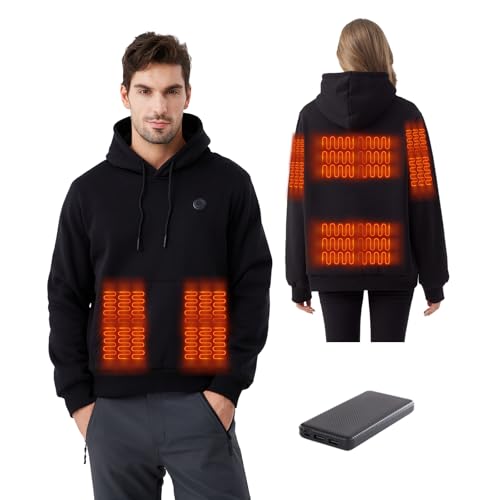
The RCVICTY is a lightweight pullover made with a cotton exterior and fleece lining. Six carbon-fiber zones are positioned across the mid-back, left and right arms, and front pockets. Unlike products that advertise very high element temperatures, its stated settings are 122°F on high, 113°F on medium, and 104°F on low. Those figures apply to the heating system rather than the outdoor conditions in which the hoodie can safely be worn. The more moderate settings may suit people who want gentle warmth during fall weather, morning commutes, or indoor use. An adjustable hood, ribbed cuffs, and a relaxed unisex shape give it the familiar feel of a casual sweatshirt.
Arm and pocket heating give this model a different emphasis from chest-focused hoodies. It may be useful for users whose hands and arms become chilled while the torso remains reasonably comfortable. The manufacturer states that a battery pack is included and that the hoodie is machine washable after the battery is removed. Buyers should confirm current battery specifications on the listing because detailed capacity and runtime information is not included in the supplied data. The relaxed cut may improve mobility, but heating elements generally transfer warmth more efficiently when they do not hang far away from the body. Compare measurements and consider the intended base layer before choosing a size.
Pros:
- Heating extends across the arms, back, and front pocket areas
- Lower heat range may be comfortable for mild conditions or indoor use
- Lightweight pullover construction is suitable for layering
- Relaxed design supports everyday movement
- Manufacturer describes the garment as machine washable after battery removal
Cons:
- No heated chest, neck, or hood panels
- Detailed battery capacity and runtime are not clearly provided
- Relaxed sizing could reduce heat transfer if the garment fits too loosely
The RCVICTY is better suited to cool fall days, indoor cold spots, and layered winter use than to exposed severe weather. Its arm and pocket panels address areas overlooked by many heated sweatshirts. Buyers wanting stronger core heat or more complete battery documentation should look elsewhere.
Best for: Mild winter conditions, casual commuting, and users who prioritize heated arms and pockets over maximum torso temperature.
Molifen Zip-Up 7-Zone Heated Hoodie for Men

The Molifen is a low-cost, full-zip heated hoodie with a polyester exterior, fleece lining, and seven carbon-fiber elements. A three-level control allows the wearer to select low, medium, or high heat. The zipper is a useful feature at this price because it allows the garment to be opened quickly during a walk, commute, or work task. The seller describes the exterior as wind-resistant, but that should not be interpreted as windproof, waterproof, or suitable for prolonged exposure without another layer. Machine washing is listed as an option, subject to removal of the power source and compliance with the garment’s care directions.
This is the budget-oriented selection, but its unusually low price requires closer attention to what is included. The supplied specifications do not clearly identify an included battery, its voltage, its capacity, or expected runtime. Heated clothing is only a complete system when the power source is compatible with the garment’s connector and electrical requirements. Check the current package contents before ordering and include a battery in the total cost if necessary. The available information also does not specify the precise location of all seven elements. Buyers who need verified neck, arm, or pocket coverage should choose a product with a clearly documented heating map.
Pros:
- Low initial garment price
- Seven carbon-fiber heating elements
- Full zipper makes temperature and layering adjustments easier
- Fleece lining supplies some warmth without electrical power
- Three heat settings support basic comfort control
Cons:
- Battery inclusion and electrical specifications are not clearly stated
- Exact placement of all seven heating elements is unclear
- Limited technical documentation makes direct comparisons difficult
The Molifen may suit a careful budget shopper who is willing to verify package contents and compatibility before purchasing. Its full-zip design and fleece lining are practical, but the lack of clear battery information prevents it from being the strongest value automatically. A low garment price can be misleading if a compatible power pack must be purchased separately.
Best for: Budget-conscious buyers who want a full-zip hoodie and are prepared to confirm the battery requirements first.
Brimekey Graphene Heated Softshell Hooded Jacket
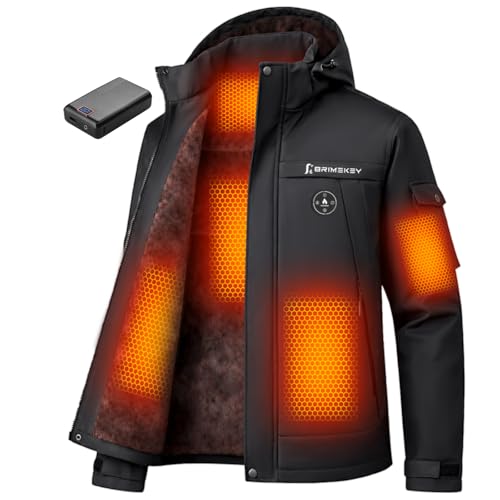
This Brimekey is closer to a hooded softshell jacket than a traditional sweatshirt, making it the weather-protection option in the guide. It combines a fleece lining with a softshell exterior and six graphene heating areas positioned at the arms, back, rear neck, and pockets. Body and arm zones have separate controls, so users can reduce power to one section while keeping the other active. The included 7.4-volt, 20,000mAh battery has a percentage display, supports compatible fast charging, and can supply power to a mobile device. Brimekey describes the shell as windproof and waterproof, but without a published test standard or hydrostatic rating, it is prudent to treat those as manufacturer claims rather than proof of protection in prolonged rain.
This jacket belongs in the selection for men who need more protection than sweatshirt fabric normally provides. It should handle breezy commutes, outdoor tasks, and intermittent winter weather better than a cotton hoodie, while the lined hood and adjustable drawcord help reduce heat loss. The cost of that protection is extra weight, bulk, and potentially lower breathability during active hiking or physical labor. Brimekey states that the garment is machine washable but should not be machine dried. As with any battery-powered jacket, it should be completely dry before the battery is reconnected or the heating system is used.
Pros:
- Softshell construction provides more weather protection than a standard sweatshirt
- Six heating areas include the arms, neck, back, and pockets
- Independent body and arm controls improve heat and battery management
- Large battery includes a digital percentage display
- Fleece-lined hood and adjustable drawcord help retain warmth
Cons:
- Heavier and bulkier than a conventional heated hoodie
- May be less breathable during strenuous activity
- No independent test rating is supplied to quantify waterproof performance
This Brimekey is the more practical option for exposed outdoor use, provided buyers understand that it is a softshell jacket rather than a casual sweatshirt. It offers broader protection and useful independent controls, but active users may prefer a lighter heated midlayer paired with a breathable shell.
Best for: Outdoor work, hunting, fishing, and cold commutes where wind resistance and light-weather protection matter.
How to Choose the Best Heated Hoodie for Men
Start with the Heating-Zone Locations
Heating-zone count is easy to compare, but placement usually matters more. Large panels across the chest and upper back warm the core, which is useful for most people. A heated collar can reduce discomfort around the neck, while hood panels may help during stationary outdoor activities. Arm and pocket panels are worth considering for work or commuting, especially if cold hands and forearms are a recurring problem.
Look at the manufacturer’s heating map rather than assuming that “eight zones” means eight large panels. Brands may count several small back sections separately, while another manufacturer may use one broad panel. Products with vague diagrams or no stated locations are harder to evaluate.
Understand Battery Voltage, Capacity, and Runtime
Battery capacity affects potential runtime, but comparing milliamp-hours alone can be misleading when batteries operate at different voltages. Watt-hours provide a more useful energy comparison when that figure is available. Battery condition, temperature, garment setting, and the number of active zones all influence how long a charge lasts.
Manufacturer runtime claims generally reflect low-heat operation under controlled conditions. High heat can reduce runtime substantially. If the hoodie is needed for a full work shift, choose a product with clear setting-specific estimates or consider whether a compatible spare battery is available. Never substitute an unrelated battery simply because its plug appears to fit.
Choose Between Pullover and Full-Zip Designs
A pullover has fewer openings and resembles a traditional casual hoodie. It can retain heat well and may fit smoothly beneath a shell. However, it is harder to ventilate quickly when activity increases.
A full-zip hoodie is easier to remove and can be opened gradually to release heat. This makes it practical for commuters moving between heated buildings and cold outdoor spaces. The zipper may add a small amount of bulk and can create a less insulated line down the center, although the electric panels often compensate for that during use.
Check the Fabric and Passive Insulation
Electric heat is only one part of the garment. Fleece lining traps warmed air and keeps the hoodie useful after the battery runs down. Thicker fleece provides more passive insulation but can become bulky under a fitted jacket. Lightweight fabric is easier to layer and pack, although it may cool quickly in wind.
Cotton blends tend to feel familiar and comfortable for casual wear, but cotton absorbs moisture and dries slowly. Polyester fleece generally manages light perspiration better, though a heated hoodie is still not an ideal base layer for strenuous activity. A moisture-managing shirt beneath the hoodie can improve comfort.
Do Not Confuse a Hoodie with a Weatherproof Jacket
Most fleece or cotton heated hoodies offer little protection against sustained wind, rain, or wet snow. Electric heat cannot prevent wind from stripping away warmth or soaked fabric from becoming uncomfortable. In exposed conditions, use the hoodie as an insulating midlayer beneath a shell designed for the weather.
A softshell hooded jacket provides better wind resistance and may shed light precipitation, but “water-resistant” and “waterproof” are not interchangeable. For extended rain or wet snow, look for a verified waterproof construction with sealed seams rather than relying solely on marketplace wording.
Fit Matters for Heating Efficiency
A heating panel transfers warmth most effectively when it sits reasonably close to the body. An excessively loose hoodie leaves an air gap and can make the heat feel weaker. A garment that is too tight can restrict movement, compress underlying layers, and create uncomfortable pressure from the battery pocket.
Use the current product-specific size chart rather than assuming that a familiar size will fit. Unisex garments may have different chest, shoulder, sleeve, and body proportions than men’s clothing. Measure the base layers you expect to wear and decide whether the hoodie will function as an outer garment or a fitted midlayer.
Consider the Battery Pocket
High-capacity batteries can be useful, but they add weight in one area of the garment. Check where the battery sits and whether that location will interfere with a backpack hip belt, vehicle seat belt, tool belt, or seated work. A smaller battery may be more comfortable for short commutes, while a larger one may be worthwhile during long, stationary periods.
Review Controls and Indicator Lights
A single button is simple, but separate controls give the wearer more flexibility. Independent circuits for the hood, arms, or body allow unused zones to be turned off, potentially conserving energy. Large illuminated buttons are easier to operate with gloves, although bright indicator lights may be distracting in a dark theater, hunting blind, or workplace.
Matching a Heated Hoodie to the Activity
| Use | Useful Features | Main Limitation to Watch |
|---|---|---|
| Daily commuting | Full zipper, compact battery, simple controls | Overheating on public transportation or indoors |
| Outdoor work | Arm heat, durable shell, large battery, separate zones | Battery interference with belts or safety equipment |
| Spectator events | Core, collar, hood, and pocket heat | Long stationary use can require more battery capacity |
| Hiking | Lightweight construction and easy ventilation | Excess heat and sweat during climbs |
| Fishing or hunting | Quiet fabric, long runtime, subdued controls | Moisture exposure and limited weather protection |
| Motorcycling | Close fit beneath protective outerwear | Loose hood material and incompatible riding equipment |
| Indoor cold spaces | Low heat setting and soft fleece | High settings may become uncomfortable quickly |
Heated clothing is often most effective during low-output activities. A person sitting in a stadium, waiting at a jobsite, or fishing from one location produces less body heat than someone walking uphill. During vigorous activity, turning the system down or off can reduce perspiration. Damp clothing may feel much colder once movement stops.
Heated Hoodie Safety and Care
- Read the supplied manual: Controls, charging requirements, and washing methods vary by model.
- Use the specified battery and charger: Similar-looking connectors do not establish electrical compatibility.
- Inspect before wearing: Stop using the hoodie if the cable, connector, battery casing, or heating area appears damaged.
- Keep the system dry: Do not connect or operate the battery while the garment or connector is wet.
- Remove the battery before washing: Secure the connector as directed and use the recommended wash cycle.
- Avoid machine drying unless expressly permitted: High heat and tumbling can damage wiring, connectors, or fabric. Several manufacturers recommend air drying.
- Do not fold a powered heating panel sharply: Excessive pressure or creasing may stress internal elements.
- Start at a lower setting: Increase heat gradually rather than immediately selecting the highest level.
- Do not use on numb or insensitive skin without medical guidance: Reduced heat sensation can make it difficult to recognize excessive warmth.
- Disconnect the battery during storage: Store it according to the manufacturer’s temperature and charge recommendations.
A heated hoodie should feel comfortably warm, not painfully hot. Turn it off immediately if a localized area becomes unusually hot, an odor develops, or the battery swells or becomes excessively warm. Do not continue using damaged electrical clothing.
Common Buying Mistakes
Choosing by Zone Count Alone
More zones are not automatically better. Five well-positioned panels around the chest, back, and collar may be more useful than eight small panels concentrated in one area. Compare coverage diagrams and independent controls.
Ignoring Whether the Battery Is Included
A low listed price can apply only to the garment. Confirm that the package contains a compatible battery and charger. If it does not, calculate the complete system cost before comparing it with an all-inclusive option.
Buying an Oversized Fit for Layering
Room for a thin base layer is useful, but excessive space reduces contact between the heating panels and the body. If substantial insulation is needed, a closer heated midlayer beneath a roomy outer shell is often more effective than an oversized heated sweatshirt.
Expecting Sweatshirt Fabric to Stop Winter Weather
Fleece helps retain warmth but does not necessarily block wind or precipitation. A heated hoodie may feel warm in calm air and lose effectiveness quickly in gusts. Plan the entire clothing system, including a suitable shell, gloves, footwear, and head protection.
Running High Heat Continuously
The highest setting warms quickly but consumes more energy and may cause perspiration. Starting high for a short preheat period and then switching to medium or low can be more comfortable, provided the manufacturer permits that use pattern.
Overlooking Care Instructions
“Machine washable” does not mean the hoodie can be laundered like an ordinary sweatshirt. The battery must be removed, and drying restrictions may apply. Following the model-specific directions helps protect the wiring and connectors.
Frequently Asked Questions
Are heated hoodies safe?
Heated hoodies can be used safely when they are undamaged, dry, powered by the specified battery, and operated according to the manufacturer’s instructions. Battery certification provides additional information about the power system, but it does not eliminate the need for correct use and routine inspection.
How long does a heated hoodie battery last?
Runtime varies widely. Heat setting, active-zone count, battery capacity, outside temperature, and battery age all affect it. Some manufacturers claim up to 10 hours on low, while high settings may last only a few hours. Treat maximum runtime figures as estimates rather than guarantees.
Can a heated hoodie replace a winter coat?
Usually not. A sweatshirt may provide insulation and electric warmth but still allow wind and moisture to penetrate. In exposed or wet conditions, wear it beneath a protective outer layer. A heated softshell jacket can provide more protection, though its specific weather rating should still be verified.
Should a heated hoodie fit tightly?
It should sit close enough for the panels to transfer warmth without restricting movement. A trim or regular fit over a thin base layer generally works better than a very loose fit. Follow the garment’s measurements because sizing differs among brands.
Can heated hoodies be machine washed?
Many can, but only under their specific care instructions. Remove the battery, secure or protect the connector as directed, and use the recommended cycle. Do not assume machine drying is allowed. Air drying is often the safer method and is specifically required for some garments.
What should be worn under a heated hoodie?
A thin, moisture-managing base layer usually works well. It keeps the heating panels close without placing them directly against bare skin. Avoid overly thick layers underneath because they can reduce the amount of heat reaching the body.
Are heated hoodies useful for hiking?
They can help during breaks, slow walks, or cold starts, but active hikers may produce enough body heat without electrical assistance. A heavy battery and fleece lining can also add bulk. Reduce or turn off the heat during climbs to limit perspiration, then reactivate it during rest periods if needed.
Is a 20,000mAh battery always better?
No. A larger battery may run longer, but it is generally heavier and bulkier. Capacity comparisons also need to account for battery voltage. For a short commute, a compact pack may be more comfortable. For outdoor work or a long event, added capacity may justify the extra weight.
Where should the heating panels be located?
For general use, prioritize the chest and back. A heated collar benefits people who lose comfort around the neck, while arm and pocket panels can help during outdoor work or stationary use. Hood heating is specialized and most useful for people who regularly wear the hood instead of a separate hat.
Can a different power bank be used?
Only if the manufacturer explicitly confirms compatibility. Voltage, connector type, polarity, and power-delivery requirements must all match. Using an incompatible battery can damage the garment or create a safety risk.
Final Recommendations
Among these eight options, the ORORO 4-Zone Heated Hoodie offers the clearest combination of a heated collar, full-zip convenience, certified battery information, and published wash durability. It is a sensible choice for buyers willing to pay more for an established system rather than the highest zone count.
The Brimekey Heated Hoodie is better for extended coverage across the arms, neck, back, and abdomen, while its battery display helps users monitor remaining power. Men who specifically want a heated hood should consider the Qdreclod. For greater wind and moisture protection, the Brimekey Graphene Heated Softshell is the more appropriate design, though it is heavier and more jacket-like.
Whatever model you choose, verify the size chart, battery contents, charging requirements, and care directions before ordering. Match the hoodie to the activity and use it as part of a complete layering system. Good panel placement, a comfortable fit, and suitable weather protection usually matter more than choosing the garment with the largest advertised number of heating zones.